Author Archives: Ricardo M. Barrera

Escape From Machiavellianism?

image from journals.cambridge.org

Escape From Machiavellianism? Thomist Themes in Twentieth Century Political Realism,
by Daniel Edward Young

Abstract

Political realism is often seen as vulnerable to the “Machiavellian temptation,” that is, to the bracketing out of moral principles in the conduct of statecraft. In this article, I explore the use of Thomist themes in the writings of Martin Wight (1913–1972), a seminal figure of the so-called English School of international relations theory. Scholars have commented on the Christian realist roots of the English School, but it is little noted that Wight's most famous essay, “Western Values in International Relations,” uses the language of Thomism. By exploring the use of Thomist concepts in Wight's thought and the parallels to be found in the thought of his contemporary, Thomist political philosopher Jacques Maritain, I show how he seeks to escape the realist temptation to Machiavellianism. I then go on to sketch out the possible shortcomings of this approach.
Article – Not in His Image: The Moderating Effect of Gender on Religious Appeals

image from journals.cambridge.org

Abstract

Religious appeals have been part and parcel of campaign strategy for decades. Most often, however, these appeals to have come from men, but little is known about how women would fare using religious appeals on the campaign trail. To remedy this, we used an experimental design to examine voter reaction to religious appeals from a female and a male candidate competing for an open United States Senate seat. We find that women's use of religious appeals is governed by the dynamics of tokenism — reinforcing traditional gender stereotypes and serving to reduce voter support of the female candidate. This suggests that women must be careful in using a key campaign tool traditionally employed by men, and that this may affect the extent to which female candidates can effectively shape voter perceptions on the campaign trail.

Details: Cambridge Journals Page

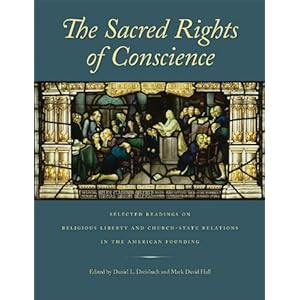
Book: The Sacred Rights of Conscience: Selected Readings on Religious Liberty and Church-State Relations in the American Founding

image from ecx.images-amazon.com Daniel Dreisbach and Mark David Hall, Editors

amazon | barnes&noble

From the bn.com website:

The Sacred Rights of Conscience provides students and scholars a rich collection of primary sources that illuminate the discussions and debates about religious liberty in the American founding era. This compilation of primary documents provides a thorough and balanced examination of the evolving relationship between public religion and American culture, from pre-colonial biblical and European sources to the early nineteenth century, to allow the reader to explore the social and political forces that defined the concept of religious liberty and shaped American church-state relations.

Including material that has been previously unavailable or hard to find, The Sacred Rights of Conscience contains original documents from both public and private papers, such as constitutions, statutes, legislative resolutions, speeches, sermons, newspapers, letters, and diary entries. These documents provide a vivid reminder that religion was a dynamic factor in shaping American social, legal, and political culture and that there has been a struggle since the inception of the Republic to define the prudential and constitutional role of religion in public culture.

Daniel L. Dreisbach is William E. Simon Fellow in Religion and Public Life for the James Madison Program in American Ideals and Institutions at Princeton University and professor in the School of Public Affairs at American University in Washington, D.C.

Mark David Hall is Herbert Hoover Distinguished Professor of Political Science at George Fox University.

Lead Article – R&P Journal, December 2011

The Bible in the Political Rhetoric of the American Founding

Daniel L. Dreisbach - American University

Abstract

The American founders frequently alluded to and quoted from the Bible in their political rhetoric. This fact alone reveals little about how and for what purposes the founding generation used the Bible and, more important, how the Bible influenced the political thought of the founding era. Drawing on some of the most familiar political rhetoric of the founding era, this article examines the founders' diverse uses of the Bible in political discourse, ranging from the strictly literary and cultural to the theological, from the stylistic to the substantive. Recognition of these distinct uses is important insofar as it is misleading to read spiritual meaning into purely political or rhetorical uses of the Bible or vice versa.

{more here}

Note from the chair – August 29, 2011

Dear all,

I hope you have had a great summer. As you will see below we have a long list of items to discuss in the section meeting during the APSA conference (Thursday, Sept 1 at 6.15-7.15 followed by a reception at 7.30-9.00).

Before listing the agenda items, I encourage each of you to

–renew the section membership

–subscribe your institution to our journal (Politics and Religion)

–volunteer for award committees (please let me know if you want to serve in book, dissertation, or paper award committees).

The agenda:

1 – Politics and Religion has a 2.5-year backlog.

To solve the problem we need more pages (we now have 3 issues per year * 7 articles per issue).

Two options:

a) 4 issues per year * 8 articles per issue = $4 increase in dues

b) 4 issues per year * 7 articles per issue = $2 increase in dues

2 – Journal Editor

As I emailed before, the following is the link to the CVs and Proposals of the three candidates for the journal's editorship:

http://community.apsanet.org/APSANET/APSANET/Resources/ViewDocument/Default.aspx?DocumentKey=2e2720e9-d8cf-4cbe-be7f-184efa6c4d7c

The meeting participants will decide whether to rank the proposals per se, or to mix candidates by constructing new co-editorships, especially for balancing the expertise on American Politics and CP/IR.

3 – Announcements:

Budget Report (Ahmet Kuru)

Journal Report (Ted Jelen)

2011 Program (Stephen Mockabee)

Mentoring (Brian Calfano)

Chair-elect (Iza Hussin)

Book Award (Committee Chair David Campbell)

Co-winners (Elizabet Hurd and Vincent P. Munoz)

Honorable mention (Mira Morgenstern)

Dissertation Award (Committee Chair Tarek Masoud)

Co-winners (Brandon Kendhammer and Samuel Goldman)

Paper Award (Committee Chair Nader Hashemi)

Winner (Lisa Blaydes)

Best,

Ahmet