New Journal Editors – Politics and Religion

image from www.denison.edu

Paul A. Djupe

Denison University

I joined the faculty in 1999 holding a Ph.D. from Washington University in St. Louis and regularly teach courses in American politics outside of the governmental institutions. I specializes in American public opinion and political behavior, with particular interests in the political influence of religion and the nature of social network influence. Uniting these two elements is a concern for the role of organizations in packaging social interaction and mandating exposure to information. My current research investigates, among other things, gender and social networks, the social psychology of religious influence, and deliberative norms in American religion. 

Angelia R. Wilson

University of Manchester

Angelia Wilson (D.Phil, University of York; B.A. Hons. McMurry University) joined the University of Manchester in 1994. Currently, she serves on the Council of the American Political Science Association, having served previously on the APSA Committee on the Status of Lesbians, Gays, Bisexuals and Transgendered in the Profession (2006-2009), as chair of the APSA LGBT Caucus and a founding member of APSA Sexuality & Politics Section.

Secularism and State Policies Toward Religion: The United States, France, and Turkey

Secularism and State Policies Toward Religion: The United States, France, and Turkey
(2009)

Cambridge Press Page Ahmet T. Kuru
San Diego State University

Why do secular states pursue different policies toward religion? This book provides a generalizable argument about the impact of ideological struggles on the public policy making process, as well as a state-religion regimes index of 197 countries. More specifically, it analyzes why American state policies are largely tolerant of religion, whereas French and Turkish policies generally prohibit its public visibility, as seen in their bans on Muslim headscarves. In the United States, the dominant ideology is “passive secularism,” which requires the state to play a passive role, by allowing public visibility of religion. Dominant ideology in France and Turkey is “assertive secularism,” which demands that the state play an assertive role in excluding religion from the public sphere. Passive and assertive secularism became dominant in these cases through certain historical processes, particularly the presence or absence of an ancien régime based on the marriage between monarchy and hegemonic religion during state-building periods.

amazon | barnes&noble

Escape From Machiavellianism?

image from journals.cambridge.org

Escape From Machiavellianism? Thomist Themes in Twentieth Century Political Realism,
by Daniel Edward Young

Abstract

Political realism is often seen as vulnerable to the “Machiavellian temptation,” that is, to the bracketing out of moral principles in the conduct of statecraft. In this article, I explore the use of Thomist themes in the writings of Martin Wight (1913–1972), a seminal figure of the so-called English School of international relations theory. Scholars have commented on the Christian realist roots of the English School, but it is little noted that Wight's most famous essay, “Western Values in International Relations,” uses the language of Thomism. By exploring the use of Thomist concepts in Wight's thought and the parallels to be found in the thought of his contemporary, Thomist political philosopher Jacques Maritain, I show how he seeks to escape the realist temptation to Machiavellianism. I then go on to sketch out the possible shortcomings of this approach.

Article – Not in His Image: The Moderating Effect of Gender on Religious Appeals

image from journals.cambridge.org

Abstract

Religious appeals have been part and parcel of campaign strategy for decades. Most often, however, these appeals to have come from men, but little is known about how women would fare using religious appeals on the campaign trail. To remedy this, we used an experimental design to examine voter reaction to religious appeals from a female and a male candidate competing for an open United States Senate seat. We find that women's use of religious appeals is governed by the dynamics of tokenism — reinforcing traditional gender stereotypes and serving to reduce voter support of the female candidate. This suggests that women must be careful in using a key campaign tool traditionally employed by men, and that this may affect the extent to which female candidates can effectively shape voter perceptions on the campaign trail.

Details: Cambridge Journals Page

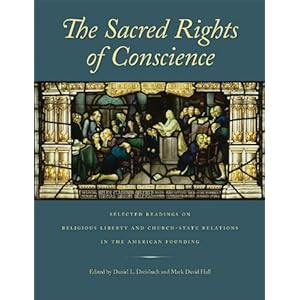
Book: The Sacred Rights of Conscience: Selected Readings on Religious Liberty and Church-State Relations in the American Founding

image from ecx.images-amazon.com Daniel Dreisbach and Mark David Hall, Editors

amazon | barnes&noble

From the bn.com website:

The Sacred Rights of Conscience provides students and scholars a rich collection of primary sources that illuminate the discussions and debates about religious liberty in the American founding era. This compilation of primary documents provides a thorough and balanced examination of the evolving relationship between public religion and American culture, from pre-colonial biblical and European sources to the early nineteenth century, to allow the reader to explore the social and political forces that defined the concept of religious liberty and shaped American church-state relations.

Including material that has been previously unavailable or hard to find, The Sacred Rights of Conscience contains original documents from both public and private papers, such as constitutions, statutes, legislative resolutions, speeches, sermons, newspapers, letters, and diary entries. These documents provide a vivid reminder that religion was a dynamic factor in shaping American social, legal, and political culture and that there has been a struggle since the inception of the Republic to define the prudential and constitutional role of religion in public culture.

Daniel L. Dreisbach is William E. Simon Fellow in Religion and Public Life for the James Madison Program in American Ideals and Institutions at Princeton University and professor in the School of Public Affairs at American University in Washington, D.C.

Mark David Hall is Herbert Hoover Distinguished Professor of Political Science at George Fox University.