Category Archives: Hubert Morken Best Book Award

2023 APSA Religion & Politics Award Winners!

Congratulations to our 2023 APSA Religion & Politics Award Winners!

Ted Jelen Best Journal Article Award

Winner: Shakhanova, Gaziza, and Petr Kratochvíl. “The Patriotic Turn in Russia: Political Convergence of the Russian Orthodox Church and the State?.” Politics and Religion 15, no. 1 (2022): 114-141.

Honorable Mention: Bleich, Erik, Jeffrey Carpenter, and A. Maurits van der Veen. “Assessing the Effect of Media Tone on Attitudes Toward Muslims: Evidence From an Online Experiment.” Politics and Religion 15, no. 3 (2022): 441-461.

Aaron Wildavsky Best Dissertation in Religion and Politics Award

Winner: Amy Lakeman, When Theology Responds: How Politics Shapes Religious Belief

Hubert Morken Best Book in Religion and Politics Award

Winner:  H. Zeynep Bulutgil, The Origins of Secular Institutions: Ideas, Timing, and Organization

Honorable Mention: Diego Fossati, Unity through Division: Political Islam, Representation and Democracy in Indonesia

Kenneth D. Wald Best Graduate Student Paper Award

Winner: Feyaad Allie (“The Representation Trap: How and Why Muslims Struggle to Maintain Power in India”)

Weber Best Conference Paper in Religion and Politics Award

Winner: Feyaad Allie (“The Representation Trap: How and Why Muslims Struggle to Maintain Power in India”)

Honorable Mention: Rajeshwari Majumdar, Richard Bonneau, Jonathan Nagler, and Joshua A. Tucker (“Reducing Prejudice and Support for Religious Nationalism Through Conversations on WhatsApp”)

Susanne Hoeber Rudolph Outstanding Scholar in Religion and Politics Award

Winners: Ron Hassner (University of California, Berkeley)

Hubert Morken Best Book Award – Call for Nominations

We would like to invite nominations for APSA’s 2023 Hubert Morken Best Book Award. The Hubert Morken Award is given for the best book dealing with religion and politics published within the previous year. The criteria for the award include the originality of the argument presented, quality of the research, innovative methods, readability of the text and the policy or practical implications of the scholarship.

To be eligible for the award, books must have been published in 2022. The nomination should include a brief statement (250-750 words) summarizing the book’s contributions and why it is nominated for the award. This statement can be sent by email to the committee chair, Vineeta Yadav (vuy2@psu.edu).

As part of the nomination, publishers should send a hard copy of the nominated book to EACH member of the awards committee at the addresses below, making sure that the books arrive by the nomination deadline, March 17th, 2023.

Self-nominations are welcome. If you have any questions, please contact the committee chair, Vineeta Yadav (vuy2@psu.edu).

Committee Members’ Contact Information:

Dr. Vineeta Yadav (Committee Chair)
309 Pond Lab
Penn State University
University Park, PA 16802

Dr. Jonathan Laurence
48 Old Colony Rd.
Chestnut Hill, MA 02467

Dr. John Green
422 Sandy Drive
Glenshaw, PA 15116

Hubert Morken Best Book Award – Call for Nominations

We would like to invite nominations for APSA’s 2022 Hubert Morken Best Book Award. The Hubert Morken Award is given for the best book dealing with religion and politics published within the previous year. The criteria for the award include the originality of the argument presented, quality of the research, innovative methods, readability of the text and the policy or practical implications of the scholarship.

To be eligible for the award, books must have been published in 2021. The nomination should include a brief statement (250-750 words) summarizing the book’s contributions and why it is nominated for the award. This statement can be sent by email to the committee chair, Michael Driessen (mdriessen@johncabot.edu).

As part of the nomination, publishers should send a hard copy of the nominated book to EACH member of the awards committee at the addresses below, making sure that the books arrive by the nomination deadline, April 15th, 2022.

Self-nominations are welcome. If you have any questions, please contact the committee chair, Michael Driessen (mdriessen@johncabot.edu).

Committee Members’ Contact Information:

Dr. Michael Driessen (Committee Chair)
John Cabot University
Via Della Lungara 233
00165 Rome ITALY

Dr. Alexander Thurston
211 North Ridge Drive
Oxford, OH 45056

Dr. Michele Margolis
Perelman Center for Political Science
133 S. 36th St. Room 401
Philadephia, PA 19104

APSA’s 2021 Hubert Morken Best Book Award

Dear APSA Religion and Politics Section Members,

We would like to invite nominations for APSA’s 2021 Hubert Morken Best Book Award. The Hubert Morken Award is given for the best book dealing with religion and politics published within the previous year. The criteria for the award include the originality of the argument presented, quality of the research, innovative methods, readability of the text and the policy or practical implications of the scholarship.

To be eligible for the award, books must have been published in 2020. The nomination should include a brief statement (250-750 words) summarizing the book’s contributions and why it is nominated for the award. This statement can be sent by email to the committee chair, David Buckley (david.buckley@louisville.edu). 
 
As part of the nomination, publishers should send a hard copy of the nominated book to EACH member of the awards committee at the addresses below, making sure that the books arrive by the nomination deadline, March 15th, 2021.

Self nominations are welcome.

If you have any questions, please contact the committee chair, David Buckley (david.buckley@louisville.edu

Committee Members Contact Information
 
Dr. David Buckley
Ford Hall, Department of Political Science
University of Louisville
Louisville, KY 40292

Dr. Laura Dudley Jenkins
Department of Political Science, ML#0375
University of Cincinnati
Cincinnati, OH 45221-0375

Dr. Eric McDaniel
13621 Campesina Dr.
Austin, TX 78727


2020 Hubert Morken Best Book in Religion and Politics Award

The winner:

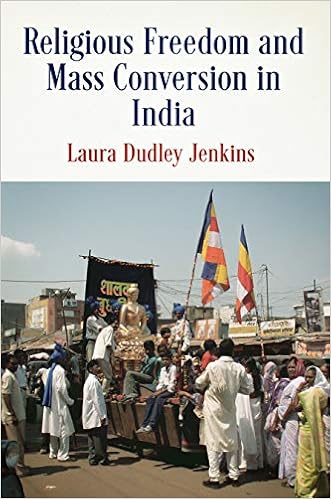
Laura Dudley Jenkins. Religious Freedom and Mass Conversion in India. UPenn Press, 2019.

amazon

Hinduism is the largest religion in India, encompassing roughly 80 percent of the population, while 14 percent of the population practices Islam and the remaining 6 percent adheres to other religions. The right to “freely profess, practice, and propagate religion” in India’s constitution is one of the most comprehensive articulations of the right to religious freedom. Yet from the late colonial era to the present, mass conversions to minority religions have inflamed majority-minority relations in India and complicated the exercise of this right.

In Religious Freedom and Mass Conversion in India, Laura Dudley Jenkins examines three mass conversion movements in India: among Christians in the 1930s, Dalit Buddhists in the 1950s, and Mizo Jews in the 2000s. Critics of these movements claimed mass converts were victims of overzealous proselytizers promising material benefits, but defenders insisted the converts were individuals choosing to convert for spiritual reasons. Jenkins traces the origins of these opposing arguments to the 1930s and 1940s, when emerging human rights frameworks and early social scientific studies of religion posited an ideal convert: an individual making a purely spiritual choice. However, she observes that India’s mass conversions did not adhere to this model and therefore sparked scrutiny of mass converts’ individual agency and spiritual sincerity.

Jenkins demonstrates that the preoccupation with converts’ agency and sincerity has resulted in significant challenges to religious freedom. One is the proliferation of legislation limiting induced conversions. Another is the restriction of affirmative action rights of low caste people who choose to practice Islam or Christianity. Last, incendiary rumors are intentionally spread of women being converted to Islam via seduction. Religious Freedom and Mass Conversion in India illuminates the ways in which these tactics immobilize potential converts, reinforce damaging assumptions about women, lower castes, and religious minorities, and continue to restrict religious freedom in India today.

_