Category Archives: Section Awards

Kenneth D. Wald Best Graduate Student Paper Award – 2021

02/15/2021

Call for Nominations

The Kenneth D. Wald Best Graduate Student Paper Award will be given annually to a conference paper studying any aspect of religion and politics presented by a Ph.D. student in political science. The conference can be affiliated with any of the US-based political science associations or a conference affiliated with another association, such as the Society for the Scientific Study of Religion, the American Academy of Religion, the Middle East Studies Association, or the International Studies Association, as long as the paper was written by a student or students enrolled in a graduate program in political science and presented in 2019 or 2020. Papers written with faculty will not be considered. Papers presented at poster sessions are welcome. The award will be announced and presented at the annual APSA conference during the business meeting. The award committee is under no obligation to make an award if no submissions merit such recognition.

Nomination Instructions: Please send nominations (self-nomination is okay) including an electronic copy of the paper and an electronic copy of the conference program listing to the committee members.

Deadline for Nominations: April 15, 2021

Award Committee:

Christopher Hale (Committee Chair)
The University of Alabama
cwhale@ua.edu 

Robert Braithwaite 
Michigan State University
brathwa1@msu.edu 

Esen Kirdis
Rhodes College
kirdise@rhodes.edu

 

Aaron Wildavsky Best Dissertation in Religion and Politics Award, 2021

Call for Nominations
Aaron Wildavsky Best Dissertation in Religion and Politics Award

APSA Religion and Politics Section invites nominations for the Aaron Wildavsky Dissertation Award. The Aaron Wildavsky Award recognizes the best dissertation in the field of religion and politics. Eligible dissertations have been defended in the last two years (2019 or 2020), and should make a distinctive contribution to the study of religion and politics, broadly understood. Please submit nominations to the committee members by email – self-nominations are welcome!

Nomination Instructions: Please send a letter of nomination (maximum 2 pages) and a copy of the dissertation to the committee members by email.

Deadline for Nominations: April 15, 2021

Award Committee:

Rina Williams (Chair)
University of Cincinnati
willi3ra@UCMAIL.UC.EDU  

Peter Henne 
University of Vermont
Peter.Henne@uvm.edu  

Kristina Teater 
US Commission on International Religious Freedom
teaterkm@ucmail.uc.edu   

Guadalupe Tuñón
Princeton University
tunon@princeton.edu

Call for Nominations – Susanne Hoeber Rudolph Outstanding Scholar Award 2021

Call for Nominations:

The Susanne Hoeber Rudolph Outstanding Scholar Award recognizes a scholar who has made outstanding contributions to the field of religion and politics. These contributions should be through a combination of excellent and widely influential scholarship, policy input/impact, public engagement, service, teaching, and mentorship. Although the committee highly encourages nominations of APSA members and takes service to APSA seriously, nominees do not have to be current APSA members. The nominees are expected to attend the following year’s APSA Annual Meeting and participate in the roundtable organized in to celebrate their work.

The award is presented annually, following a review of applications by the committee. The winner will be honored with a plaque, a monetary award of $500, and a roundtable symposium honoring their work at the APSA Annual Meeting of the next calendar year. (The 2021 Susanne Hoeber Rudolph Awardee will be honored at the 2022 APSA Annual Meeting both during the business meeting and the roundtable).

The award is intended as an addition to, not replacement for, the practice of awarding special ‘lifetime achievement awards’ for scholars who have made substantial contributions to the Section on the event of their retirement. Instead, this is meant to reward political scientists (including those who are mid-career) who have made a substantial contribution to the field of religion and politics.

Nomination letters and the CVs of the nominees are due to the Committee Chair, Jocelyne Cesari (jcesari@hds.harvard.edu) by April 1, 2021. The nomination letter should clearly describe how the nominee fulfills the criteria described above. Since this award is meant to reflect peer recognition, self-nominations will not be considered.

Award Committee:
Jocelyne Cesari (jcesari@hds.harvard.edu)
Joel Fetzer (joel.fetzer@pepperdine.edu)
Sultan Tepe (sultant@uic.edu)

Honorable Mention – 2020 Hubert Morken Best Book in Religion and Politics Award

Honorable Mention:

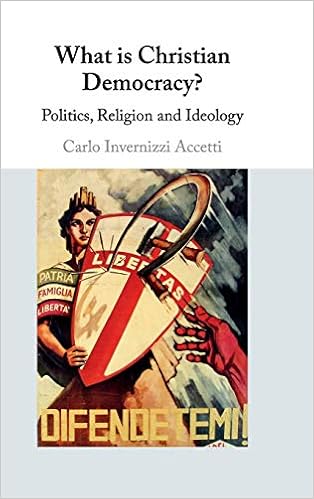
Carlo Invernizzi-Accetti. What is Christian Democracy? Politics, Religion and Ideology. Cambridge University Press, 2019.

amazon

Christian Democratic actors and thinkers have been at the forefront of many of the twentieth century’s key political battles – from the construction of the international human rights regime, through the process of European integration and the creation of postwar welfare regimes, to Latin American development policies during the Cold War. Yet their core ideas remain largely unknown, especially in the English-speaking world. Combining conceptual and historical approaches, Carlo Invernizzi Accetti traces the development of this ideology in the thought and writings of some of its key intellectual and political exponents, from the mid-nineteenth century to the present day. In so doing he sheds light on a number of important contemporary issues, from the question of the appropriate place of religion in presumptively ‘secular’ liberal-democratic regimes, to the normative resources available for building a political response to the recent rise of far-right populism.


2020 Hubert Morken Best Book in Religion and Politics Award

The winner:

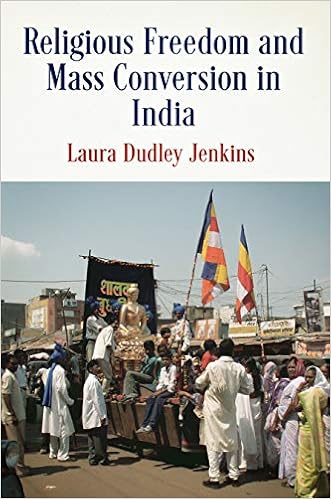
Laura Dudley Jenkins. Religious Freedom and Mass Conversion in India. UPenn Press, 2019.

amazon

Hinduism is the largest religion in India, encompassing roughly 80 percent of the population, while 14 percent of the population practices Islam and the remaining 6 percent adheres to other religions. The right to “freely profess, practice, and propagate religion” in India’s constitution is one of the most comprehensive articulations of the right to religious freedom. Yet from the late colonial era to the present, mass conversions to minority religions have inflamed majority-minority relations in India and complicated the exercise of this right.

In Religious Freedom and Mass Conversion in India, Laura Dudley Jenkins examines three mass conversion movements in India: among Christians in the 1930s, Dalit Buddhists in the 1950s, and Mizo Jews in the 2000s. Critics of these movements claimed mass converts were victims of overzealous proselytizers promising material benefits, but defenders insisted the converts were individuals choosing to convert for spiritual reasons. Jenkins traces the origins of these opposing arguments to the 1930s and 1940s, when emerging human rights frameworks and early social scientific studies of religion posited an ideal convert: an individual making a purely spiritual choice. However, she observes that India’s mass conversions did not adhere to this model and therefore sparked scrutiny of mass converts’ individual agency and spiritual sincerity.

Jenkins demonstrates that the preoccupation with converts’ agency and sincerity has resulted in significant challenges to religious freedom. One is the proliferation of legislation limiting induced conversions. Another is the restriction of affirmative action rights of low caste people who choose to practice Islam or Christianity. Last, incendiary rumors are intentionally spread of women being converted to Islam via seduction. Religious Freedom and Mass Conversion in India illuminates the ways in which these tactics immobilize potential converts, reinforce damaging assumptions about women, lower castes, and religious minorities, and continue to restrict religious freedom in India today.

_