Terence Wood, Christopher Hoy, and Jonathan Pryke
China’s rise as an aid power is changing the way political elites and policymakers in OECD countries think about aid. Responding to the perceived geostrategic leverage that China gains from its aid, decisionmakers have increasingly viewed their country’s aid as a means of advancing foreign policy goals overseas.
The impact of Chinese aid on the attitudes of donor country publics is less clear. Public opinion rarely determines aid policy on its own. Yet research suggests it has some influence. In our recent, open access article in the Experimental Journal of Political Science, we tested whether increased knowledge of China’s rise as an aid donor changes how publics in other donor countries view the aid their government gives.
To do this we ran a survey experiment on a representative sample of Australians (n=2001). The experiment focused on China’s rise as an aid donor to the island states of the Pacific. Neighbouring Australia is the largest donor to the Pacific, a region it views as important to its interests.
Full details of our study are in the paper. In the paper we also detail findings from a separate experiment run to see if our results could be replicated in New Zealand. (Results in New Zealand were broadly similar.)
Below, we focus on the central findings from Australia – findings comparing the attitudes of a control group with those of two treatment groups. The first treatment group was given a balanced vignette, written as if it were a newspaper article, describing China’s rise as an aid donor to the Pacific in a clear but measured manner. Because reporting on China in Australia’s media often takes a strident tone, we provided the second treatment group a more forceful vignette, which described China’s rise as an aid donor in dramatic terms. After reading the vignettes, the treatment groups were asked three questions about Australian aid. The control group, which received no vignette, was asked the same questions.
First, we asked participants whether the Australian government should give more or less aid. (The question contained accurate information on how much aid Australia gave.)
Views on whether Australia gives too much foreign aid
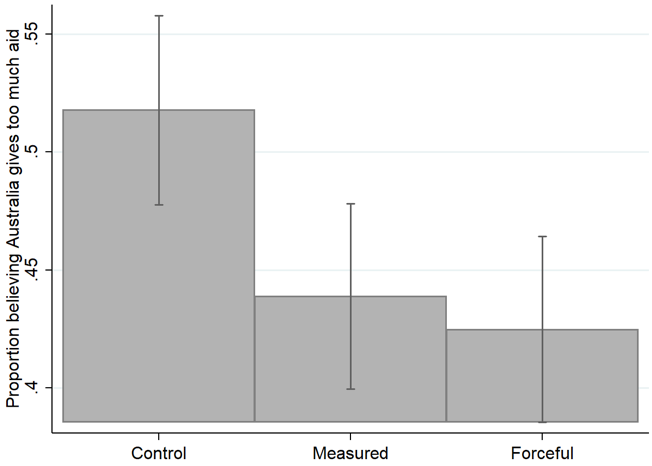
The difference between the effects of the measured and forceful treatments was not statistically significant, but the difference between both treatment groups and the control group was striking. Both vignettes caused the belief that Australia gives too much aid to fall markedly – nearly 10 percentage points in the case of the forceful treatment.
The second question we asked was whether Australia, which like many donor countries gives aid all around the world, should focus more of the aid it currently gives on the Pacific region.
Views on whether Australia should focus more aid on the Pacific
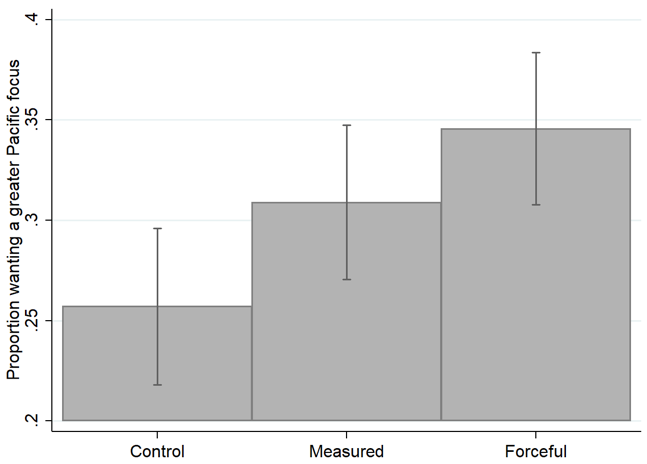
Once again, the treatments changed Australians’ views. On average, treated participants wanted more aid focused on the Pacific. Of the two treatments, the forceful vignette appears to have had the largest effect, although the difference between the forceful and measured treatments was not statistically significant.
The findings from these first two questions fit broadly with the behaviour of policymakers. When treated with information on China’s rise, Australians became less likely to think Australia gave too much aid, and more likely to want aid focused on the Pacific. Our third question returned a surprise, however.
In this question we asked participants whether they thought Australian aid should be given primarily to help people living in poor countries, or primarily given to advance Australian interests. The chart below shows the share of respondents who favoured advancing Australia’s interests.
Views on using aid to advance Australia’s interests
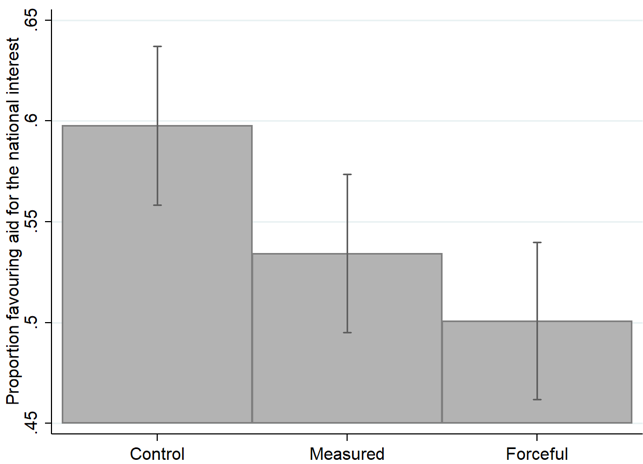
The treatments clearly shifted opinions. Average views in both treated groups differed from the control group in a manner that was statistically significant and substantively meaningful. Once again, the forceful treatment appeared to have had the largest effect, although, once again, the difference between the forceful and measured treatments was not statistically significant.
The surprise in the third experiment lay in the direction of the effects. The vignettes made readers less likely to want Australian aid used to advance Australia’s interests and more likely to want aid used to help people living in poverty overseas. China’s rise has led Australian policymakers to increasingly view their country’s aid as a geostrategic tool. The effect on public preferences appears to be in the opposite direction.
The next task for work in this area will be learning why Australians became less enthusiastic about using aid to advance Australian interests. A possibility that warrants further investigation is that Australians may not see China as a threat to Australia, yet they are concerned with its impact on people in the small island states of the Pacific.