José Gabriel Castillo and John Hamman
Does a democratic election confer legitimacy to the elected authority? Does this, in turn, improve collective action? In other words, does democracy, by itself, lead to higher economic growth and development? Despite the abundance of social science research on this topic, we still lack a definite answer to such fundamental questions. The causal relationship between political regimes and economic outcomes remains elusive, largely due to the implausibility of conducting controlled randomized trials across national governments. And yet, these same experimental methods enable us to examine these hypotheses in a controlled setting. We conduct a laboratory experiment to study the relationship between democratic selection and political accountability and find muted effects in group behavior and outcomes. However, all is not lost; we find that leaders do respond in pronounced beneficial ways to being democratically elected, compared to randomly appointed leaders.
Modern societies enforce collective action through delegation of sanctioning duties, which relies on the legitimacy of authority to promote socially desirable outcomes. And yet, whether for general economic outcomes or organizational behavior and performance, Hargreaves Heap et al. (2020) point out that we know little about the causal mechanisms connecting governance and individual behavior. Do democratic institutions succeed by selecting the best delegates, or does participatory democracy influence accountability beyond selection through its inclusiveness? In this paper, we experimentally control for this selection effect to examine whether electoral political accountability functions as a source of institutional legitimacy to promote collective action.
Contrary to the common belief about the influence of democratic institutions on economic outcomes, empirical evidence on delegated enforcement remains inconclusive. Some research finds that democratically appointed “third party” leaders increase public good contributions relative to randomly appointed outside agents (Baldassarri and Grossman, 2011; Grossman and Baldassarri, 2012). Others find no significant differences in group behavior in social dilemmas (Castillo et al., 2020; Hargreaves Heap, Tsutsui and Zizzo, 2020). Beyond known experimental nuances, the source of legitimacy in democratic institutional arrangements remains a challenge for causal inference.
To deepen into this elusive relationship, we use a hybrid two-by-two design, where subjects play a public goods game with and without punishment opportunities for an authority selected from within the group. This feature captures the fact that in local or municipal government, agents are frequently selected from among area, and their decisions are costly to everyone, including themselves. In one treatment dimension, we vary whether the central sanctioning authority is elected by the group or exogenously appointed by the experimenter. Here, we make a novel contribution to the study of randomly appointed versus democratically elected by designing this process to control for the selection effects of voting. The second dimension varies the frequency with which selections are made, either once for the duration of the session or repeatedly. In this way we study whether re-election concern incentivizes the authority to act in the electorate’s best interests (Ferejohn, 1986).
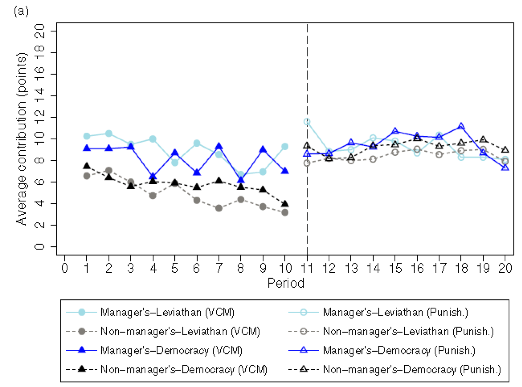
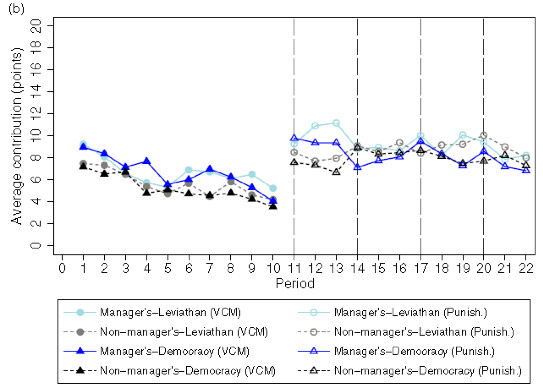
Contribution’s dynamics by roles.
(a) Single election
(b) Multiple elections
In contrast to democratically determined contributions (Hamman et al, 2011), we find that democratically elected sanctioning authority has muted effects on group outcomes. That is, when we control for selection effects that determine the quality of the authority, we find no difference in group outcomes between democratic and exogenous mechanisms. Because participants knew the exogenous selection rule, their beliefs about the quality of the chosen candidate, we argue, may not differ between institutions. This raises the question of how information plays a role. While selection criteria can often be observed in democratic elections, many non-democratic institutions certainly lack transparency in selecting their leaders, which directly affects their legitimacy.
Interestingly, we do find that democratically elected authorities facing repeated elections no longer free ride. Instead, their contributions are in line with those of their fellow group members. In contrast, democratically elected authorities who do not face repeated election (i.e., in the absence of political accountability), as well as exogenously appointed authorities, contribute significantly less to the public good than their fellow group members.
Beliefs over the advantages of democratic institutions in centralized power environments, such as in representative democracies, rely on features that either act jointly or are independent of the power delegation mechanism. Democracy alone is not enough. However, jointly with political accountability, a crucial feature of modern governance, it offers different incentives to the authorities. In our study, this “responsibility effect,” reflected in higher contribution behavior, arises only under a democracy.