2018 Special Projects Fund Recipients
In 2018, the American Political Science Association awarded ten, $25,000 grants to collaborative projects aimed at advancing the discipline of political science.
Read more about the 2018 Special Projects Fund Recipients below, and visit their individual pages for even more information, including updates on their progress.
Avoiding “Day Zero” in the U.S. & Global South: Climate Justice in Teaching & Policy Action
This project aims to add a deep understanding of politics to analyses of institutional change in pursuit of climate justice in urban areas in the Global South. The members of the project team are a group of political scientists and other social scientists who have done extensive field research in Africa, Asia, and Latin America. They draw on their ongoing research collaborations and longstanding institutional linkages to develop pedagogical resources and co-produce a handbook designed to serve the needs of policymakers, municipal administrators, and civil society activists.
This project makes significant contributions to the discipline by fostering cross-regional and multidisciplinary collaborations between political scientists in the United States and academics, policymakers, municipal officials, and activists from the Global South. The project also seeks to demonstrate new modes of public engagements to address the formidable challenges of climate justice.
PIs: Prakash Kashwan, (University of Connecticut), Frank Matose (Rondebosch, Cape Town, South Africa), Navnita Chadha Behera (University of Delhi, New Delhi), Lauren M. MacLean (Indiana University)
The Collaborative Study of Race in the Americas: Team Building in the 21st Century
This project was developed by a group based in the National Conference of Black Political Scientists (NCOBPS). Its purpose is to bring together a group of scholars from the United States and Brazil to initiate a long term interdisciplinary, cross-national, collaborative program to study the transectional nature of racial politics in the Americas, focusing on African-descended populations. The instant part of the program is intended to join scholars in a series of working groups, both in the U.S. and Brazil. The working groups will use ongoing collaborative projects as the base for designing and initiating new research projects, as well as implementing strategies to obtain continuing external support. The workshops will begin in the fall of 2018, continue through the March, 2019 NCOBPS meeting, and conclude during the fall of 2019 at Florida International University. The proposal is modeled after the highly successful Race & Democracy in the Americas Project as updated for the present era.
Read more about participants’ activities at the 2018 National Conference of Black Political Scientists
US-Based TEAM
Danielle Clealand, Florida Atlantic University
David Covin, California St. University-Sacramento
Minion K. C. Morrison, University of Delaware, PI
Ollie Johnson, Wayne State University
Gladys Mitchell-Walthour, University of Wisconsin- Milwaukee
Minion K. C. Morrison, University of Delaware, PI
Dianne Pinderhughes, University of Notre Dame
James Steele, North Carolina A & T University
Kathie Stromile Golden, Mississippi Valley State University
Dalila Fernandes de Negreirios, University of Wisconsin-Milwaukee
BRAZIL-Based TEAM
Paulo Barreto, Federal University of Bahia*
Silvio Humberto, University of Feira de Santana
Cleber Juliao, State University of Bahia
Cloves Oliveira, Federal University of Bahia
Maristela Rosa da Silva, Federal University de Juiz de Fora*
Edilza Sotero, Federal University of Bahia
Raquel de Souza, Independent Scholar
* Independent of APSA grant
FORMAL CONFERENCE ACTIVITIES OF PARTICIPANTS
Papers
- Paulo Barreto. “Visual culture of privileges, ways of looking and (in)visibility of black bodies in Brazilian contemporary society.”
- Edilza Sotero, “The color of politics: Political Traditions and Black Movements in Brazil (1945-1955).”
- Raquel de Souza, “Ethnographic Notes from a War Zone: Surviving and Resisting.”
- Cloves Oliveira, “The new Bahian enigma: electoral preferences and ethnic vote in the city of Salvador, Bahia – Brazil (1985-2016). Why did Black Rome never elect a black mayor?
- Silvio Humberto, “Black Protagonism and Parliament.”
- Maristela Rosa da Silva, Federal University de Juiz de Fora,* “Anti-Black Voting in the 2018 Brazilian Presidential Election.”**
- Dalila Fernandes de Negreirios, University of Wisconsin-Milwaukee, “Afro-Brazilian Studies: A Panorama of the Field.”
- Ivanilda Amado Cardoso, “The Construction of Brazilian Black Identity through Communication and Media.”**
- John Thomas, “The Politics of Black Inclusion in Ecuador and Peru.”**
- Danielle Clealand, “Political Inclusion and Inclusion of Afro-Puerto Ricans in Puerto Rico”
- Marcus Johnson, “Electoral Discrimination: The Relationship Between Skin Color and Vote Buying in Latin America.”
- Dianne Pinderhughes, “Black Women as Elected Officials”
Conference Section Leaders
- Danielle Clealand, “Afro-Latino Politics.”
Panel Leaders/Discussants
- David Covin, “The Collaborative Study of Race in the Americas.”
- Gladys Mitchell-Walthour, “Black Media in Race, Education, and Anti-Black Voting in Brazil”
- Minion K. C. Morrison, “Race and Racismo in Latin America”
- Ollie Johnson, “Race and Racismo in Latin America”
- Danielle Clealand, “New Dialogues and Directions in the Study of Afro-Latino Politics”
Plenary Sessions
- Minion K. C. Morrison
- Danielle Clealand
- Cloves Oliveira
NCOBPS Fiftieth Anniversary Honorees
This annual meeting represented the 50th anniversary of NCOBPS. Former Presidents of the organization were special honorees. Four members of the RDA team have served as President of the organization:
PIs: KC Morrison, (University of Delaware), David Covin (California State University, Sacramento)
Read more about the Collaborative Study of Race in the Americas Conferences
The Effects of Women’s Mentoring Workshops on Career Outcomes in Political Science
Mentoring is often proposed as a programmatic solution to help improve women’s advancement in academic careers. While several women-focused conferences are regularly held in political science, these programs vary greatly in scope and content, and none include the randomized admissions necessary for causal evaluation. This project involves implementing a randomized women’s mentorship workshop in political science, which will replicate and extend the important results reported by Blau et al. (2010). The planned replication expands on previous evaluations by incorporating several waves of pre- and post- conference surveys, which are designed to isolate the particular mechanisms by which women-only mentoring events improve women’s career outcomes.
PI: Tali Mendelberg (Princeton)
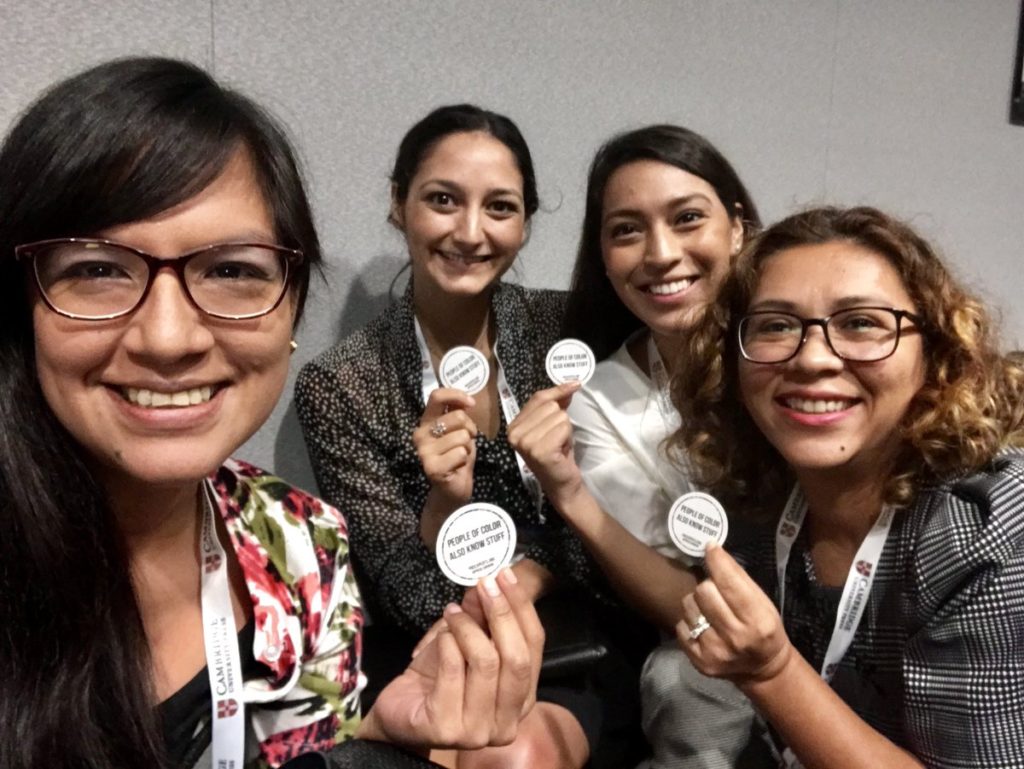
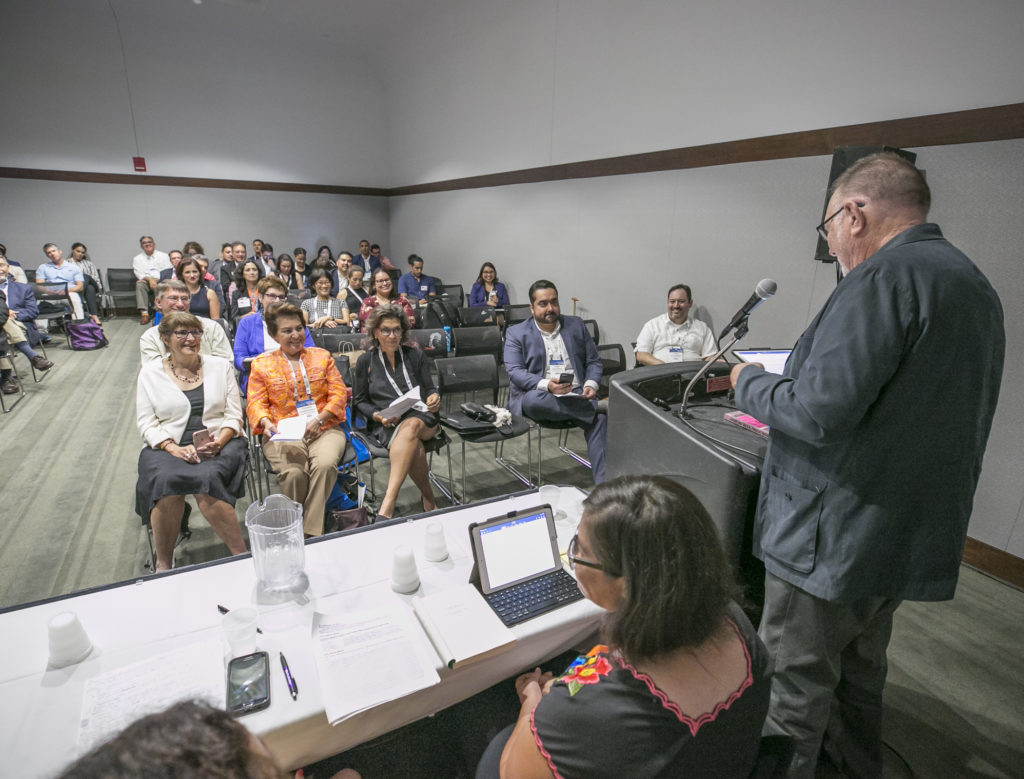
Looking Back and Moving Forward: The 20th Anniversary Workshop of the APSA Latino Caucus
This project, led by the Latino Caucus of APSA, focuses on a one-day conference at the 2018 annual meeting of the American Political Science Association in Boston, MA, to commemorate the 20th anniversary of the founding of the Latino Caucus. The conference will involve mentoring sessions, professional development seminars, research panels, and an awards dinner on August 29, 2018. Attendance is open to all members of APSA.
Looking Back and Moving Forward advances diversity by celebrating with all interested attendees but also improves retention among underrepresented scholars by including scholars across institutions and from different disciplinary approaches, fostering critical opportunities for mentorship and career development.
Read a full recap of the Looking Back Moving Forward Workshop
PIs: Mario Guerrero (California State Polytechnic University Pomona), Valerie Martinez-Ebers (University of North Texas), Tony Affigne (Providence College), Jessica Lavariega Monforti (California Lutheran University), Melissa Michelson (Menlo College)
#MeTooPoliSci
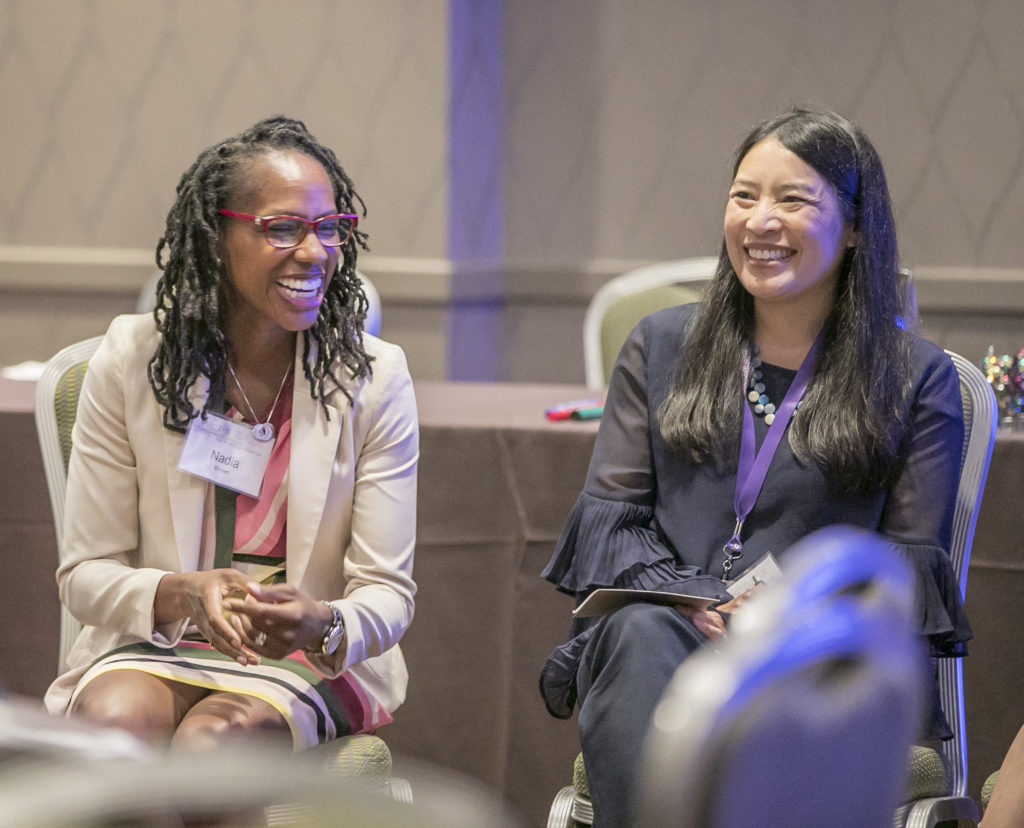
Started by Tarana Burke in 2007 to stand with young women of color who survived sexual assault, the #MeToo campaign was intended to let women know that they were not alone. Today, the phrase is a viral awareness campaign on social media that has inspired others to share their stories, stand in solidarity with survivors, and challenge a culture of pervasive sexual assault and harassment. With the support of a 2018 Special Projects Grant, the Women’s Caucus has engaged with this cultural moment to bring awareness to gender bias and discrimination, sexual harassment, assault, and misconduct in our discipline – with #MeTooPoliSci.
This collaboration aims to use the collective power of women in political science to dispel the shame, embarrassment, and secrecy that surrounds issues of gender-based bias and harm and to catalyze sustainable change.
Updates
- July 2018 – Special Projects Grant Awarded
- September 2108 – Annual Meeting Workshop
- February 2019 – NSF ADVANCE Grant Writing Workshop
- July 2019 – NSF ADVANCE Grant Awarded
1,025,000
Total funding awarded
“The outstanding scholars engaged in the #MeTooPoliSci project have great potential to help our discipline make progress”
Rogers Smith
APSA President
If you’re interested in learning more about the Women’s Caucus for Political Science, the #MeTooPoliticalScience project, or the Special Projects Fund please contact centennial@apsanet.org. To learn about APSA’s efforts to support diversity and inclusion in the profession, visit https://www.apsanet.org/diversityprograms.
Political Science Pre-Graduate School Workshops
The Pre-Graduate School Workshop grant aims to increase student success in applying for and completing advanced degrees in Political Science and related disciplines. The workshops focus on providing support to students in regions with high concentrations of first-in-their-family college students, many of whom are attending HSI and HSBC institutions.
PIs: Susan Scarrow (University of Houston), Jeffrey Church (University of Houston), John Ishiyama (University of North Texas), Gabriel Sanchez (University of New Mexico).
Fast Facts:
14: Workshops held
390: Students served
Workshops were held at thirteen different institutions: The University of Houston, The University of North Texas, Texas Tech, Texas A&M Corpus Christi, the University of New Mexico, Xavier University, Prairie View A&M, Oklahoma State University, The University of Arizona, Arizona State University, The University of Texas Rio Grande Valley, California State University Northridge, and the Metropolitan State University Denver
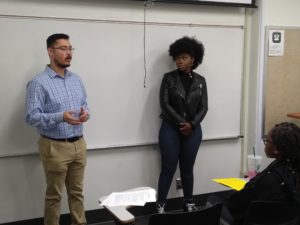
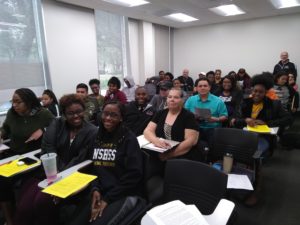
University of Houston political science major Isaiah Johnson and doctoral student Henrietta MacPepple, pictured above left, talking week with Prairie View A&M students about graduate school and how and why to get there. This pre-graduate school workshop was organized by Drs. Nathan Mitchell, Michael Nojeim (both Prairie View A&M University) and Susan Scarrow (University of Houston)
Research Coordination Network for Race, Ethnicity, and Politics Scholars
This project aims to establish a Research Coordination Network (RCN) of scholars working in the field of Race, Ethnicity and Politics (REP). The network will seek to advance three goals to strengthen the subfield. First, it will engender collaborations between REP scholars working across the four main subfields of political science. Second, the network will encourage REP scholars to think more systematically about the ways in which our research programs can identify regional and global patterns in racial and ethnic politics. Third, the network will boost the tenure rates of scholars of color within the discipline by focusing on the recruitment, training, and mentoring of a diverse cohort of assistant professors. The main activity of the network will be a two-day workshop held annually at one of the institutions of the principal investigators. With this proposal we are seeking $25,000 to help defray the costs of the inaugural workshop to be held at Arizona State University (ASU) during the 2018-2019 academic year.
PIs: Alvin Tillery (Northwestern University), Rodney Hero (Arizona State University), Juliet Hooker (Brown University), Michael Jones-Correa (University of Pennsylvania), Jane Junn (University of Southern California)
Rethinking the Undergraduate Political Science Major: A Conference Proposal
This conference will act as a first step towards rethinking the undergraduate political science curriculum as proposed by the Wahlke Report. To that end the conference invited papers and presentations that reconsider the recommendations of the Wahlke Report in different institutional settings. The organizers include representatives from Public Research Universities (where the major is growing the most), Regional Public Universities (which had been excluded from the original Wahlke task force), and Liberal Arts Colleges and Community Colleges (which had no representation on the original task force). The conference itself engaged scholars from a variety of institutions including majority or Predominately White Institutions (PWIs), Historically Black Colleges and Universities (HBCUs), Hispanic Serving Institutions (HSIs), Tribal Colleges and Universities (TCUs) and others.
View the call for applications (now closed) here
View presentations from the conference on APSA Preprints
PIs: John Ishiyama (University of North Texas), Marijke Breuning (University of North Texas), Terry Gilmour (Midland College), Fletcher McClellan (Elizabethtown College), Cameron Thies (Arizona State University), Renee Van Vechten (University of the Redlands), Sherri Wallace (University of Louisville)
Studying Chinese Politics to Integrate and Contribute to Political Science
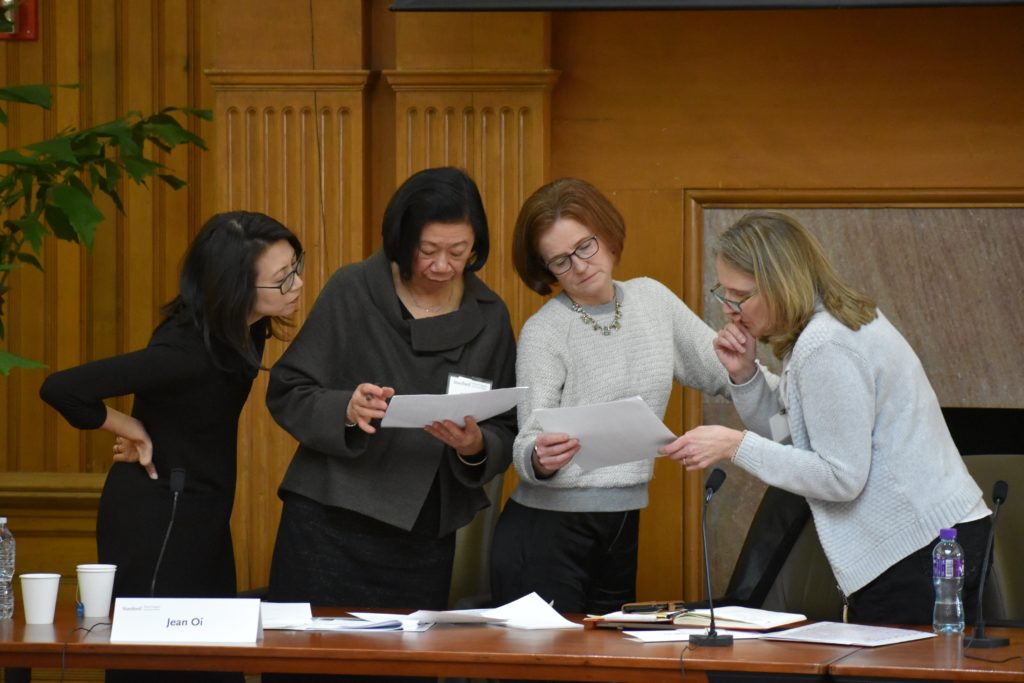
This project focuses on a multi-institutional conference on “Studying Chinese Politics to Integrate and Contribute to Political Science” to be held on December 14 and 15, 2018 at Stanford University. The aim of this conference is two-fold: 1) to convene comparativists who study China to consolidate the different, short “waves” of research within the China studies field; and 2) to use those findings to promote deeper integration of China politics into the discipline of political science. This gathering of political science scholars will hash out ideas, discuss best practices, identify key literatures and types of data that can advance the discipline itself while also prompting deeper scholarly inquiries about China. This December conference at Stanford will develop an agenda of key questions and methodologies to be further developed in a series of conferences that will rotate among five universities (Duke, Harvard, Michigan, MIT, and Stanford).
Read more about the “State of the Field of Chinese Politics” conference at Stanford
PIs: Jean Oi (Stanford), Melanie Manion (Duke University)
Visions in Methodology Conference
This grant will support two conferences—one in 2018 and one in 2019–sponsored by Visions in Methodology (VIM). VIM is a mentoring and outreach organization with the goal of supporting women faculty and graduate students in political science who study political methodology broadly defined (a multi-method approach). In addition to providing a forum to share scholarly work, VIM also serves to connect women in a field where they are under-represented.
The Special Projects Grant will provide support for 15 women faculty to attend the 2019 VIM annual conference and for 10-20 women and members of historically under-represented groups to attend the 2018 Political Methodology VIM pre-conference.
Learn more about Visions in Methodology
PIs: Caroline Tolbert (The University of Iowa), Jan Box-Steffensmeier (Ohio State University), Sara Mitchell (The University of Iowa)