TLC at APSA: Teaching Democracy: Reflection, Innovation and Imagination
Saturday, September 7, 2024
The seventh annual TLC at APSA (Teaching and Learning Conference at APSA) is a full-day event that seeks to promote the scholarship of teaching and learning and enhance the role of teaching in the discipline of political science.
7:30 a.m.
Welcome & Breakfast
- Colin Brown, Northeastern University (TLC at APSA program co-chair)
- Bobbi Gentry, Bridgewater College (TLC at APSA program co-chair)
8:15 a.m.
WORKSHOP SESSIONS
Pedagogy Café
- Integrating Education Politics and Policy into the Political Science Curriculum, Chloe ONeill, Teachers College, Columbia University and Cameron Arnzen, Brown University
- Learning Communities and Political Science: An Ideal Pairing, Juan Carlos Huerta, Texas A&M University-Corpus Christi
- You’re Not the Only One with Mixed Emotions: Affective Teaching Strategies, Lanethea Mathews-Schultz, Muhlenberg College and Jennie Sweet-Cushman, Chatham University
- Reflections on Three Years of Teaching in an Active Learning Classroom, Terry Gilmour, Midland College and Sondra Beedie Richards, Midland College
- Teaching as a Contingent Faculty Member, Jonathan Ring, University of Tennessee, Knoxville and Eunsook Jung, University of Wisconsin-Madison
- Teaching at a Community College, Mark L. Johnson, Minnesota State Community and Technical College and Helen Chang, CUNY-Hostos Community College
Using Census Data to Join Community Engagement and Project-Based Learning
Peter J. Woolley, Fairleigh Dickinson University; Kathryn A. Foster, The College of New Jersey
Democracy Skills Training for Civil Society Professionals
Jonathan Mendoza
The Power of Questions and Stories for Teaching Politics
Titus Alexander, Democracy Matters
10:00 a.m.
WORKSHOP SESSIONS
Civic Education and Active Learning: Applying the CDIO and Debate Models
- Robert John McMonagle, Neumann University
- Susan Kenyon, Canterbury
- Christ Church University
- Ryan M Savitz, Neumann University
Teaching about Political Violence through Games and Exercises
Charmaine N. Willis, Skidmore College, Joseph W. Roberts, Roger Williams University
Teaching Information Literacy: Reflecting on Research in the Age of AI
Kimberly MacVaugh, Georgetown University, Rachel Olsen, UNC Greensboro
Teaching Qualitative Methods in Undergraduate Political Science
- UFOs in the Cold War: A Fun Assignment for Teaching Digital Archival Research, Spyridon Kotsovilis, University of Toronto Mississauga; Meaghan Valant, University of Toronto Mississauga
- Teaching Philosophy of Science: Foundations of a Methods Sequence, Michelle Day Weitzel, The Graduate Institute, Geneva
- Community-Based Learning as Research Method Learning, Lara-Zuzan Golesorkhi, University of Portland
- Human Subjects and the IRB as a Tool for Teaching Qualitative Research Methods, Kimberly Zagorski, University of Wisconsin, Stout
- Teaching Interviewing Techniques to Undergraduate Students, Mary P. McGuire, SUNY, Cortland; Pedro G. dos Santos, College of Saint Benedict; Xiaoye She, California State University San Marcos; Carmen Victoria Walker, Bowie State University
12:00 p.m.
Plenary Address & Luncheon
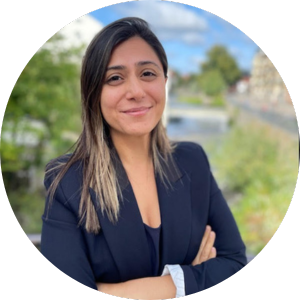
Featuring Plenary Speaker: Dr. Nazita Lajevardi of Michigan State University
Educating for change: Teaching race in a climate of hostility
Dr. Nazita Lajevardi is an Associate Professor in the Department of Political Science at Michigan State University. She researches issues related to public opinion and political behavior through the lens of religious and racial identity, and evaluates how stigmatized groups fare in American democracy. Broadly, her scholarship is related to race and ethnic politics, political behavior, voting rights, and immigration politics. Her scholarship has been published in numerous venues, including American Political Science Review, The Journal of Politics, Political Behavior, and Cambridge University Press, among others. Read more
2:00 p.m.
TRACK PANEL SESSIONS 1
Track: Reimagining Civic Engagement Track
Pathways to Motivated Student Agency through Intentional Civic Pedagogy
- Social Benefits Motivate Young Adult Civic Engagement, William O’Brochta, Texas Lutheran University
- From Representation to Agency: A Framework for Student-Centered Civic Pedagogy, Trygve Throntveit, Wilson Center
- Making Citizens Through Engaged Civic Pedagogy, Abigail Dym, University of Pennsylvania
- Timothy Snyder’s “On Tyranny”: Twenty Lessons in the Political Theory Classroom, Khristina Hamilton Haddad, Moravian College
- Uncovering Longitudinal Outcomes of K-20 Civic Engagement Partnerships, Michele Calderon, University of Maryland Baltimore County; Alison Rios Millett McCartney, Towson University
Track: Innovations in Active Learning and Democracy
Games, Simulations, and Tools in Context
- Downscaling Simulations and Role-Playing Games with an Element Design Approach, Michael Bossetta, Lund University, Sweden
- Illustrating US and Soviet Interests through a Short Board Game, Petra Hendrickson, Northern Michigan University
- Using an Analogy to Teach Informal Agreements and Bargaining in IR Courses, Zachary Houser, Boise State University
Track: 21st Century Skills: Literacy, Analysis, Research and Writing
New Perspectives and Practices on Student Writing
- Building Blocks for Learning: Scaffolding Writing-Based Learning Activities, Dale Mineshima-Lowe, Birkbeck, University of London
- Helping Struggling Student Writers: Interactive Strategies to Improve Success, Leanne C. Powner, Leanne C Powner Coaching and Editing
- Rethinking Writing Assignments for Advocacy, Discovery, and Democracy, Bobbi Gentry, Bridgewater College
Track: Equity, Diversity, Inclusion, Justice, and Accessibility
Understanding and Combating Bias, Controversy, and Fear in PS Curriculum & Classroom
- Dialogic Approaches as Tools for Human Rights Education, Erica E MacDonald, University of Connecticut; Rachel Jackson, University of Connecticut
- For an Anti-racist Approach to Methods Education, Leonardo Falabella, University of California, San Diego
- Let’s Talk about Diversity: The Use of Discussion in Alleviating Students’ Fears, Shannon McQueen, West Chester University of Pennsylvania
4:00 p.m.
TRACK PANEL SESSIONS 2
Track: Reimagining Civic Engagement Track
Enhancing Student Civic Connections through Experiential and Active Learning
- Dinners for Democracy: A Peer-to-Peer Nonpartisan Voter Education Program, Edie Goldenberg, University of Michigan, Ann Arbor; Logan Woods, University of Michigan; Phoebe Henninger, University of Michigan
- School Participatory Budgeting: Student Voice and Choice, Tara Lynn Bartlett, Arizona State University
- The Academic and Civic Opportunities of Student Poll Working, Barbara Smith Robertson, Georgia State University Perimeter College
- Building a Partnered Learning Pathway: Lessons from CIVDEM@Mac, Joanna Massie, McMaster University; Karen Bird, McMaster University
Track: Innovations in Active Learning and Democracy
Applied and in the Field Active Learning
- Making Sausage: Experiencing the Mechanics of Democracy,
John W. Williams, Principia College - The Challenge of Using TikTok in a Political Science Classroom, Shyam K. Sriram, Canisius University
- The Classroom on Trial: Sending Undergraduates to Court, Douglas M. Cantor, Rutgers University
Track: 21st Century Skills: Literacy, Analysis, Research and Writing
Preparing Students for New Challenges
- An Information Literacy Initiative Gets Creative: Navigating Campus Pitfalls, Heather L. Katz, Southwestern Oklahoma State University
- Updating Beliefs? Insights from a Course on International Development, Nu Thuy Duong Ton; Cristina Corduneanu-Huci, Central European University
- Tools for Reimagining Democracy: Undergraduate Research, Andra Olivia Miljanic, University of Houston
Track: Curriculum
Institutional Research on PS Majors & PhD Students & Curricular Evaluations of Research Methods
- A Study of PhD Programs in Political Science, and the Future of Political Theory, Matthew Stein, College of Southern Nevada – Social Sciences
- Learning at Any Age: Teaching Political Science to Adult Learners Charmaine N. Willis, Skidmore College, Keith A. Preble, Miami University
- Why Students Choose Political Science & Satisfaction at Graduation: A Case Study, Sarah Brown, University of Colorado Boulder, Janet L. Donavan, University of Colorado, Boulder
5:45 p.m.
Political Science Education Organized Section Business Meeting
7:00 p.m.
7th TLC at APSA Reception
Marriott Philadelphia Downtown, Salon H
THANK YOU
Thank you to the 2024 TLC at APSA Program committee for their hard work and dedication in planning this year’s TLC at APSA.
- Colin Brown, Northeastern University (co-chair)
- Bobbi Gentry, Bridgewater College (co-chair)
- Helen Chang, Hostos Community College, CUNY
- Wendy Johnston, SUNY Adirondack
- Kevin G. Lorentz II, Saginaw Valley State University
- Chapman Rackaway, Radford University
- Shyam Sriram, Canisius University