
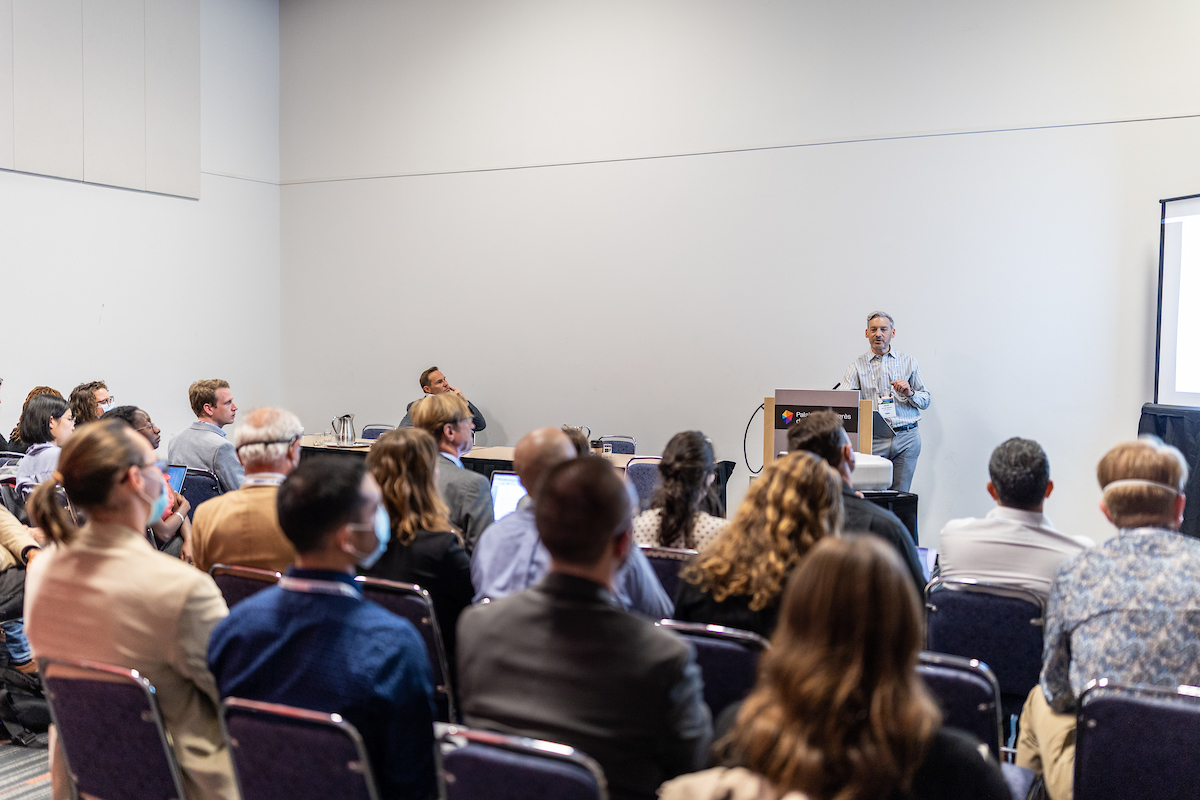
Plenary Events: APSA and the 2023 program co-chairs, Zoltán Búzás, University of Notre Dame, and Felicity Vabulas, Pepperdine University, look forward to your participation in these plenary panels and sessions during the meeting!
‣ 119TH APSA PRESIDENTIAL ADDRESS
| 119th Presidential Address: Global Governance Confronts the Onslaught of Disinformation |
 Lisa Martin, APSA President, University of Wisconsin, Madison Lisa Martin, APSA President, University of Wisconsin, Madison Thursday, August 31, LACC, Petree Hall C, at 6:30 p.m. to 7:30 p.m. 119th Annual Meeting Opening Reception APSA hosts the Opening Reception. All attendees are invited to enjoy hors d’oeuvres and cocktails. Thursday, August 31, LACC, Petree Hall D, at 7:30 p.m. to 8:30 p.m. |
‣ PLENARY SESSIONS
Plenary: The Debate over “National Conservatism”
Friday, September 1, LACC, Petree Hall C, at 2:00 p.m. to 3:30 p.m.
Surveys regularly show that modern academic disciplines and institutions are primarily populated by liberals, so conservatives often contend that their views are not well understood or represented in fields like political science. This plenary panel aims to deepen understanding of contemporary conservatism by focusing on the rise of “National Conservatism.” The National Conservative movement has held a series of international conferences since 2019, and in 2022 over 80 leading conservative academics and public intellectuals from the U.S. and 10 other nations joined in endorsing a 10-point National Conservatism “Statement of Principles.” It rejects “universalist ideologies” such as “liberal imperialism” and “globalism” in favor of “upholding national traditions.” Other conservatives have criticized the National Conservatives, some contending that the principles of the Declaration of Independence and of universalistic religious faiths deserve more allegiance than nation-states. This panel will include leading voices from inside and outside academia who represent both National Conservatism’s adherents and its conservative critics, so that political scientists can better grasp the themes and debates characterizing conservatism in the U.S. and many other nations today.
Presenters:
Rogers Smith, University of Pennsylvania (Moderator)
Emily Jashinsky, The Federalist
Charles Kesler, Claremont McKenna College
Lucas E. Morel, Washington & Lee University
Saurabh Sharma, American Moment
Carol M. Swain, Texas Public Policy Foundation
Plenary: Mis- and Disinformation in an Age of Human Rights
Friday, September 1, LACC, Petree Hall C, at 4:00 p.m. to 5:30 p.m.
Political communication can be fraught with mis- and disinformation, with crucial consequences for human rights. Misinformation related to covid-19, for example, undercuts the right to health. Election-related disinformation corrodes the right to free and fair elections. Falsehoods that amplify hatred against racial and ethnic, religious, or political minorities violate the right to non-discrimination and freedom of religion. At the same time, apparent attempts to fight mis- and disinformation could be employed against political opponents and critical journalists, undermining the right to assembly, free speech and freedom of the press. Our plenary panel will focus on rights and responsibilities in a world of mis- and disinformation. How can we conceive of and undertake our work and civic responsibilities in ways that lower the harm of mis- and disinformation? How should we rethink complex governance structures, political communication, democracy, algorithms, or freedom of expression, if at all? This panel aims to bring together a diverse group of political scientists, representatives of big tech, government officials, and members of nonprofits to grapple with problems and solutions posed by dis- and misinformation.
Presenters:
Beth A. Simmons, University of Pennsylvania (Moderator)
Suparna Chaudry, Lewis & Clark College
Adela Levis, U.S. Department of State
Kenneth Roth, Princeton School of Public and International Affairs
Jack L. Snyder, Columbia University
‣ BREAKING NEWS PANELS
Breaking News: The Supreme Court and the Future of Affirmative Action
Thursday, August 31, LACC, Petree Hall C, at 2:00 p.m. to 3:30 p.m.
The most anticipated Supreme Court rulings this summer include two cases pertaining to affirmative action–students for Fair Admissions (SEFA) v. University of North Carolina and SEFA v. Harvard University. The oral arguments suggest that the court will strike down or at least weaken considerations of race in school admissions. This panel engages with a number of timely questions related to these rulings: Did the Supreme Court’s rulings validate these expectations? To what extent do these most recent rulings depart from the court’s precedent? What are the effects on student bodies, especially at elite institutions and HBCUs? How will universities respond to these rulings? Are there suitable race-neutral alternatives that will ensure the diversity of student populations? How do these rulings shape our understanding of racial discrimination? What are the implications beyond higher education?
Presenters:
Paula McClain, Duke University (Moderator)
Ricardo Ramirez, University of Notre Dame
Richard Henry Sander, UCLA School of Law
Michele Siqueiros, College Campaign
Janelle Wong, University of Maryland
Breaking News: Examining CRT & DEI Mis(Dis)Information: The Intellectual, Policy, and Political Implications in the Academy and Beyond
Friday, September 1, LACC, 511B, at 10:00 a.m. to 11:30 a.m.
Over the past several years, both attention to and recognition of systemic inequities that create marginalization based on race, ethnicity, gender, religion, sexuality, ability and more have grown. Simultaneously, there is growing hostility to attempts to identify and ameliorate past and present inequities. This backlash has resulted in significant social and political attacks on explanations of those inequities (e.g., Critical Race Theory [CRT]), as well as efforts developed to ameliorate the inequities themselves (e.g., Diversity, Equity, and Inclusion [DEI] measures). This hostility is driven by mis- and dis-information campaigns, and a significant amount of ire is currently targeted at higher education (in particular, scholars that engage with DEI work and CRT), as well as professors from marginalized identity groups (regardless of the focus of their research). This roundtable will include a discussion of the current state of these attacks and their effects on scholars, higher education, and society as well.
Presenters:
Courtenay W. Daum, Colorado State University
Jessica L. Lavariega Monforti, California State University Channel Islands
Loan K. Le, Institute for Good Government & Inclusion
Liz Norell, University of Mississippi
Periloux Peay, University of Oklahoma
Kaitlin Kelly Thompson, Tufts University
Isaac Kamola, Trinity College
Sergio C. Wals, University of Nebraska, Lincoln
Breaking News: Generative AI and the Future of Political Science
Saturday, September 2, LACC, Petree Hall C, 10:00 a.m. to 11:30 a.m.
One of the fastest changes in political science research, teaching, and practice over the past year has been the rapid ascendency of generative artificial intelligence (AI). Tools like Chat GPT stand to change the way we think about and “do” political science. This panel engages with an emerging set of questions as we consider how AI will change the traditional landscape of political science. What are the ethical implications of generative AI in the classroom, in our careers, and throughout political processes? What are the threats that generative AI might pose to critical thinking? What opportunities could generative AI present for shattering worn-out practices, and how can we capture those benefits? Perhaps most importantly for the theme of the conference, how might generative AI create challenges for an increasingly polarized world that is rife with mis- and disinformation? And might generative AI provoke human rights concerns that upstage some of today’s most difficult dilemmas?
Presenters:
Julie George, Cornell University (Moderator)
Joshua A. Goldstein, Georgetown University
Todd C. Helmus, RAND Corporation
Michael R. Tomz, Stanford University
Filippo Trevisan, American University
Nicole Wu, University of Toronto