
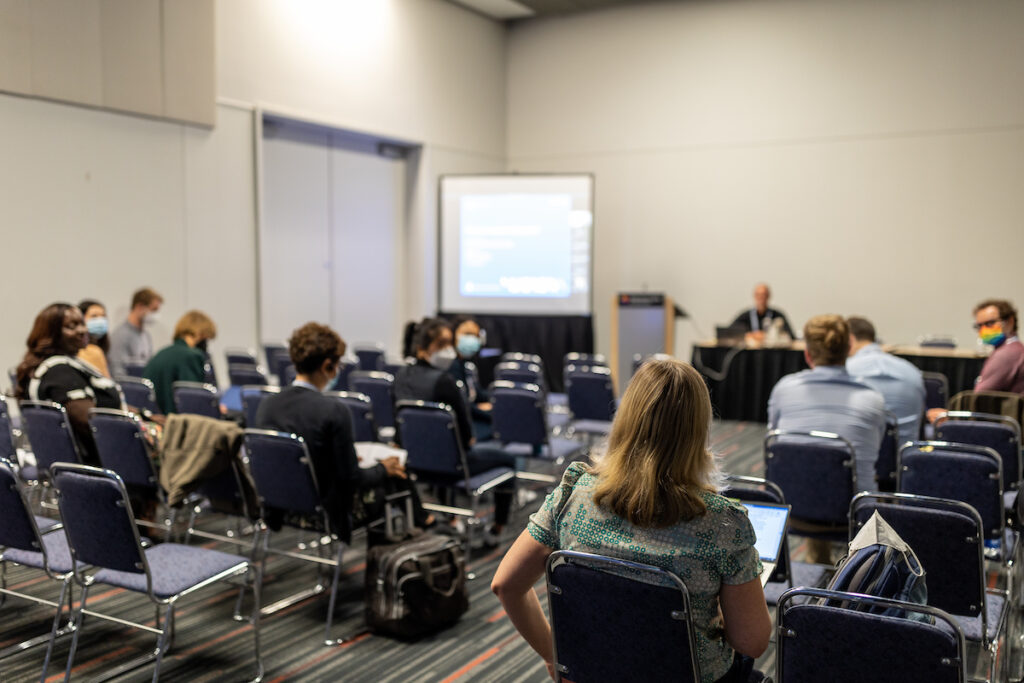
APSA is excited to announce the return of the Emerging Scholars Symposium and Lightning Rounds at the 2023 Annual Meeting!
These Lightning Round Sessions will take place Friday, September 1 and Saturday, September 2, in the Los Angeles Convention Center. The Emerging Scholars Symposium kicks off on Friday with the first of the Lightning Round sessions, which have a format similar to PechaKucha. Each Lightning Round session will have coffee available for all participants. The events will conclude on Saturday evening with the Graduate Student Happy Hour.
Each scholar will have five minutes to present, followed by five minutes of feedback or Q&A. This format provides a structured framework, providing presenters with not only the chance to share their research at the world’s largest political science meeting, but the opportunity to develop and enhance their research communication skills through a concise presentation as well. Coffee will be available to participants throughout all Lightning Rounds.
Many thanks to Pi Sigma Alpha for sponsoring the attendance of the the undergraduate Lightning Round students.
/*! elementor – v3.14.0 – 26-06-2023 */
.elementor-accordion{text-align:left}.elementor-accordion .elementor-accordion-item{border:1px solid #d5d8dc}.elementor-accordion .elementor-accordion-item+.elementor-accordion-item{border-top:none}.elementor-accordion .elementor-tab-title{margin:0;padding:15px 20px;font-weight:700;line-height:1;cursor:pointer;outline:none}.elementor-accordion .elementor-tab-title .elementor-accordion-icon{display:inline-block;width:1.5em}.elementor-accordion .elementor-tab-title .elementor-accordion-icon svg{width:1em;height:1em}.elementor-accordion .elementor-tab-title .elementor-accordion-icon.elementor-accordion-icon-right{float:right;text-align:right}.elementor-accordion .elementor-tab-title .elementor-accordion-icon.elementor-accordion-icon-left{float:left;text-align:left}.elementor-accordion .elementor-tab-title .elementor-accordion-icon .elementor-accordion-icon-closed{display:block}.elementor-accordion .elementor-tab-title .elementor-accordion-icon .elementor-accordion-icon-opened,.elementor-accordion .elementor-tab-title.elementor-active .elementor-accordion-icon-closed{display:none}.elementor-accordion .elementor-tab-title.elementor-active .elementor-accordion-icon-opened{display:block}.elementor-accordion .elementor-tab-content{display:none;padding:15px 20px;border-top:1px solid #d5d8dc}@media (max-width:767px){.elementor-accordion .elementor-tab-title{padding:12px 15px}.elementor-accordion .elementor-tab-title .elementor-accordion-icon{width:1.2em}.elementor-accordion .elementor-tab-content{padding:7px 15px}}.e-con-inner>.elementor-widget-accordion,.e-con>.elementor-widget-accordion{width:var(–container-widget-width);–flex-grow:var(–container-widget-flex-grow)}
Graduate Student Lightning Round: Social Movements, Conflict, Coalitions
LACC, 153C
Friday, 9/1, 4:00 p.m. -5:30 p.m.
Chair & Discussant: Juan Corredor-Garcia, CUNY Graduate Center
Papers:
Correcting Misinformation as an Antidote against Intergroup Violence
Nimrod Nir, The Hebrew University of Jerusalem
Defueling violent intergroup escalation when it erupts is a major quest for scholars and change agents – as it may prevent casualties and further aggression between warring parties. One categorical predictor of such violence can be found in misinformation about outgrips, as presented in social and traditional media. During May of 2021, Israel experienced an unprecedented outbreak of ethnic violence between its Jewish and Arab citizens, causing fatalities on both sides and hundreds wounded. During these riots, researchers conducted two studies aimed at increasing opposition to intergroup violence. The first study revealed that although the vast majority of each group strongly opposed violence, each group perceived their respective outgroup as significantly more supportive of violence. Moreover, group members’ own support for violence was strongly associated with their meta-perception of the outgroups’ support for violence. The second study experimentally examined whether correcting participants’ misperceptions of their outgroup support for violence – would decrease participants’ own support for intergroup violence. Results show that exposing Jewish and Arab citizens to information presenting outgroup opposition to violence led to significantly stronger opposition to violence against the outgroup – in the midst of a nationwide outbreak of violent attacks. A third study, conducted during a violent intergroup outbreak coined as the “June Terror Wave”, have replicated these results, while addressing various limitations of the first two studies. Taken together, the current findings affirm the importance and potency of minimizing intergroup biases and misperceptions of the outgroup via corrective information in reducing intergroup violence and escalation – as it occurs.
Gender (In)Equality and Rebel Sexual Violence
Changwook Ju, Yale University
In this study, I argue that rebel groups are incentivized to engage in more sexual violence when confronting governments of more gender-equal societies because reports of rebel sexual violence in such communities lead to potentially greater public opprobrium on the state security system while undermining state power through emasculation. To evaluate this argument, I utilize panel data on gender equality (and inequality) and wartime sexual violence between 1989 and 2011. Using careful operationalizations of gender (in)equality and novel empirical analyses addressing oft-incomplete sexual violence data, I demonstrate that polity-level gender equality is associated with a significant increase in the prevalence of rebel sexual violence, whereas gender inequality correlates with a lower prevalence of rebel sexual violence. The argument and evidence presented in this study render gender (in)equality as a causal explanation for rebel sexual violence, contributing to the recent trend that brings gender analysis back into the study of gender-based violence.
#HereToStay: United We Dream’s Twitter Response to the Rescinding of DACA
Jessica Taghvaiee, University of California, Irvine
On September 5th of 2017, the Trump Administration announced the rescinding of the DACA program (Deferred Action for Childhood Arrivals). This immigration policy decision had immense ramifications for immigrant communities, in particular the young adults protected by DACA. Aside from traditional avenues for political participation, social media platforms have become a key tool for illegalized immigrant youth to actively engage in political discourse and organize political actions on their behalf. This project uses qualitative coding based on a grounded theory approach to study how the leading undocumented youth-led national immigrant organization, United We Dream (UWD), used Twitter as a tool to respond to 2017’s political environment surrounding DACA and its rescinding. The research findings highlight the ways in which UWD strategically used certain types of tweets and narratives to respond to the political opportunities and threats posed by anti-immigrant rhetoric and policy decisions.
Lost in Translation: Barriers to Financial Inclusion and State-Building in Ghana
Ghita Chraibi, University of Virginia
Research on state-building has resurfaced since the 2000s. This paper fits within this renewed research interest in state-building and is specifically concerned by the ways in which barriers to financial inclusion, as a tool for social benefits delivery, give us insights into state-building processes in developing countries. The paper focuses on language barriers in the context of Ghana as there are over eighty different languages spoken throughout the country. Ghana with its extremely high level of language diversity, has thus far struggled with linguistic homogenization. The state has nonetheless allowed English to become the sole language formally used for the access to and delivery of financial services. Therefore, this paper recognizes the importance of financial inclusion for state-building especially in light of the digitization of financial services and the growth of the Financial Technology (FinTech) sector. It further explores the hypothesis that a lack of linguistic homogeneity in Ghana, coupled with relatively high illiteracy levels, negatively impacts financial services take-up, which in turn hinders state-building efforts more generally as, among others, it impacts the state’s ability to channel social benefits.
Migration Management & Transit Zones: Resistance through Collective Migration
Natasha Sofia Martinez, York University
In October 2018, thousands of transnational migrants demanded entry into Mexico after marching from the Northern part of Central America to the Mexico-Guatemala land border, with the goal of transiting through Mexico to reach the U.S. border and claim asylum. The media labelled this movement as a Migrant Caravan. In fact, one only needs to type in #MigrantCaravan on Twitter or Instagram to see images and videos of the diverse bodies that comprised this movement – i.e., groups of men, women, children, youth, and families (Varela Huerta, 2020) migrating mainly from Honduras, El Salvador, and Guatemala. While the phenomenon of transnational “collective migration” finds its origins in the late 20th century (Torre & Mariscal, 2020; Marchand, 2021), the magnitude, power, and grass-roots configuration of the contemporary Migrant Caravan has led scholars to classify it as a “transnational social movement” or “refugee camp on the move” (Rizzo Lara, 2021; Ramos, 2018, as cited in Varela Huerta, 2020). While regional commitments, like the 2017 Comprehensive Regional Protection and Solutions Framework (MIRPS), were established to encourage “regional cooperation among countries of origin, transit and destination for a greater responsibility sharing in matters of prevention, protection and durable solutions” (“MIRPS”, 2022), Migrant Caravans have continued, even during the COVID-19 pandemic, with 6,000 people transiting through southern Mexico in June 2022 (Lopez & Cegarra, 2022). These factors make migration in the region a matter of crisis, warranting further investigation. My paper seeks to respond to the questions (1) how do regional migration management regimes reflect contemporary manifestations of colonialism? And (2) how is transnational collective migration vital to agency, survival, and resistance? My paper has 3 central objectives: to analyze regional migration management commitments and its application in transit countries in the global South, specifically in Latin America (Rizzo Lara, 2022); to illuminate how these region propagates and maintains colonial mechanisms of control (Estévez Lopez, 2014; Marchand, 2021); and, most importantly, to bring migrant and refugee agency to the forefront by highlighting how transnational collective migration are vital to agency and survival and resistance within transit countries (Varela Huerta, 2020). This paper’s dual focus on the global-local impacts of the global migration management regime on transit countries in the global South, exemplified by transit countries in Latin America, and the experiences of those within transnational collective migration groups, like Migrant Caravans, can bring greater awareness to improve regional and international policies by balancing agency and collective security. By focusing on Latin America as a region in the global South, and more specifically, by looking at the transit corridor between Mexico and Guatemala, this paper seeks to combine an analysis of colonialism and migration to unpack how border externalization and migration management policies within transit countries in the global South are contemporary manifestations of colonialism (Menjívar, 2014; Mayblin & Turner, 2021; Bauder, 2022). Border externalization processes can be defined as “a series of extraterritorial activities in sending and in transit countries at the request of the (more powerful) receiving states (e.g., the United States or the European Union) for the purpose of controlling the movement of potential migrants” (Menjívar, 2014). This process is necessary to explore because “the efforts of the Global North to externalize border policing and enforcement include increasing participation in policing the migration flows of countries in the Global South” (Menjívar, 2014) leading to further insecurity of the migrant. Transit countries are also important because they “play a fundamental role for the receiving countries in implementing management strategies to control migratory flows from the Global South” (Adepoju et al., 2010; as cited in Menjívar, 2014). Therefore, putting colonialism in conversation with migration reveals a politics of exclusion such that there is “[a] return of the colonial time in our age in various forms and its spectral presence makes migration a matter of crisis” (Samaddar, 2020). Secondly, this paper seeks to build on the work of global South feminist scholar Dr. Varela Huerta, by advancing the claim that Migrant Caravans can be understood as “a strategy of migrant self-defense, of collective self-care (Glockner, 2019), as a new type of migrant struggle” (Varela Huerta, 2020) that responds to deficiencies associated with the global migration management regime (Ghosh, 2000) by transforming physical and figurative boundaries of belonging (Nyers, 2019; Rizzo Lara, 2021).
Rebel Monetary Governance
Annjulie Vester, UC Santa Barbara
When and why do rebel groups build more complex financial institutions like central banks or treasuries? Generally, rebels provide various social services, protection and policing, and judicial governance to their constituents. On the contrary, and aside from what we already know about rebel taxation and resource exploitation, little is known about if and how rebels govern monetarily or fiscally. In October 2014, rebels in Eastern Libya disconnected the regional central bank branches in Benghazi and Bayda from the Libyan automated clearing system (RTGS) and began building their own central banking system. Using some of the pre-existing infrastructure, the Eastern Central Bank began rivaling the official Central Bank of Libya in issuing counterfeit currency, bonds, letters of credit, and determining new interest rates. While this move enabled a great influx of revenue for the rebels, it led to a deterioration of the economy and the Libyan peace process. A few months earlier, ISIS insurgents in Iraq captured Mosul where they would govern for the next years. There, ISIS fighters robbed the regional branch of the Bank of Iraq and abandoned it. Unlike the Libyan rebels, the Islamic State did not attempt to build its own central banking system, despite having access to similar, established infrastructure. Both rebel groups engaged in other forms of governance, yet it is puzzling that only the Libyan rebels attempted some form of state-like financial governance when both had the opportunity to do so. In the 21st Century, the case of the Eastern Central Bank in Libya appears unique or incidental – not part of a larger trend in rebel governance. Yet, historical corollaries exist. For example, as taxation and borrowing proved insufficient to fund its war effort, the American Confederacy began printing money and issuing government securities. Causing hyperinflation, the Confederate government tried to pass monetary legislation to contract the money supply – to no avail. This ultimately contributed to its demise. In this paper, I investigate the presence and absence of rebel financial governance during cases of civil war and de facto states. Building an original dataset cataloguing these cases, I test two competing explanations: first, whether such institutions are tools of war finance, or, alternatively, if they exist to promote civilian-rebel relations or foreign sponsorship, as the rebel governance literature suggests. Crucially, these explanations hinge on how sovereignty is defined, the stage of the war or conflict, and whether rebel groups evolve into sovereign or de facto states, if at all. The conditionality of rebel financial intentions and institutions across time and place inform broad trends in governance that are yet unexplored in the literature. I argue that a group’s intentions to extract resources, bolster legitimacy, and respond to the needs of economic elites are main drivers of financial governance institutional development.
UN Sanctions on Rebel Groups and Persistence of Civil Wars
Merve Keskin, University of Pittsburgh
Why external actors impose sanctions on rebel groups is crucial to understanding the effectiveness of economic coercion on conflict resolution. Existing research about the effect of economic sanctions on civil war dynamics focuses on state-targeted economic sanctions. However, rebel groups have recently been sanctioned more than states in civil wars. Yet, we still have a limited understanding of what determines sanctions’ effectiveness in the civil war. I argue that the effect of international sanctions, particularly the UN, on conflict duration is contingent upon the depriving role of sanctions on rebel governance. Once UN sanctions specifically target rebel groups with governance, they weaken the rebel’s overall capacity and prevent insurgents from sustaining their power over people, depriving the group and reducing conflict duration. Through Cox regression using time-series cross-sectional data covering all civil wars fought between 1975 and 2019, this paper shows that when UN sanctions focus on reducing rebels’ power to govern and control, wars last shorter than those the UN has not targeted.
Violence and Victims: Understanding Student Activism in Mexico
Erika Arias, Syracuse University
In 1968, thousands of students filled the Tlatelolco area in Mexico City, to protest the excessive power of the government and lack of political freedom. Police and military were deployed to subdue the public unrest resulting in death, imprisonment, and torture of hundreds. Similar student mobilization continued throughout the Mexican Dirty War period and into the modern day. Does the Tlatelolco Massacre continue to influence protests and public discourse? Does a history of state violence affect the political mobilization of new generations? Within the last few years, Mexico has seen a rise in public frustration centered on discrimination, femicide, and violence. This study analyzes the frequency of protests throughout various presidencies, and the scale to which demands can garner support. Demands in 1968 gained thousands of participants, yet other protests in various time periods have not been able to reach such height. Building on past theories of state violence and political mobilization, I claim that the Tlatelolco Massacre was a pivotal movement for Mexican students and has had a positive effect on mobilizing new generations of protesters. I claim that the frequency of protests and the number of participants increases when there are inclusive shared social grievances. This project uses mixed-methods to test the theory. I use archived reports and secondary sources for data particularly for the Dirty War period, and ACLED data for modern protest events.
Graduate Student Research Lightning Round: Identity, Public Opinion
Virtual
Sat, 9/2, 2:00 p.m. – 3:30 p.m.
Chair & Discussant: Biko Koenig, Franklin & Marshall College
Papers:
Conscription and Support for Redistribution: A Tale of Inter-class Contact
Fernando Javier Sánchez Monforte, Nuffield College, Oxford University
Does contact between people from different socioeconomic classes increase support for policies aiming to reduce inequality? The scarcity of research addressing this question, as well as the shadow of self-selection looming over most of it, calls for more research on the relationship between inter-class contact and political attitudes. Lack of inter-class contact may be connected to three phenomena which are known to undermine support for redistribution: underestimations of the actual level of inequality in society, reduced possibilities for empathy processes towards outgroups (people from other social classes), and more meritocratic and less structuralist understandings of inequality. I contribute to this field by examining an unexplored institution in the existing literature: mandatory military service. Drawing on Spanish cross-sectional data from the European Social Survey (ESS) and following a difference-in-differences approach with women as the control group, I find that being born in a conscripted cohort around the cut-off point of the removal of conscription in Spain significantly increases the probability of supporting redistribution among males, relative to females. The results, which are robust to many different specifications, successfully pass a placebo analysis in which I specify different (false) dates for the suspension of conscription, as well as placebo tests on a variety of unrelated political attitudes (e.g., attitudes towards immigrants, pro-environmental attitudes). Furthermore, I rule out several competing hypotheses to the mechanism about inter-class contact, such as worse economic conditions or reduced levels of institutional trust among males born in conscripted cohorts, or increased sympathy towards the right-wing party which abolished conscription among exempted cohorts. Finally, I provide two analyses suggesting that removal of conscription reduced inter-class contact. First, males in conscripted cohorts have a better understanding of their own material position in society, compared to their counterpart females and to individuals in non-conscripted cohorts. This, I argue, may be caused by more socioeconomically diverse networks of the first group, who get more accurate information about the actual distribution of resources in society. Second, I find a positive diff-in-diff effect on the likelihood of having a partner from a different social position, a more direct indicator of inter-class contact. This paper aims to extend the very scant research on inter-class contact and preferences for redistribution in a twofold way. First, by proposing a different way to look at contact between classes beyond the geographical setting of most existing studies. Second, by trying to overcome the self-selection concern which may be present in that type of analysis, whose results could be explained by the sorting of individuals into neighbourhoods according to their political preferences.
Divine Intervention: Catholicism and Abortion in American/Canadian Healthcare
Angela Kothe, Cornell University
In the United States and Canada, the number of religiously affiliated hospitals is rising even as populations become less religious. The rise in Catholic hospitals has been particularly consequential because it is driven by mergers with secular institutions. The result is a decline in hospitals generally, as well as a decline in facilities willing to provide contraception and abortions. Existing theories of the countries’ health systems address the influence of unions, medical associations, insurers, and the insured, but have long neglected the role of religious organizations in shaping institutional configurations. This paper theorizes the Catholic Church’s growing presence in healthcare as the result of partisan shifts during debates over contraception and abortion access in the 1960’s and 70’s. The Church sees its ministerial obligation to provide health services as requiring its support for universal care and its opposition to contraceptive access. I use primary sources to argue that abortion rights test bishops’ commitment to universal care, and that partisan strategies in the wake of this tension affects healthcare expansions. In the American case, parties kept abortion salient, so bishops were incentivized to obstruct healthcare expansions using contraceptive access as a wedge issue. While in the Canadian case, Catholics consolidated into a secular party, so bishops and partisans were incentivized to temper conflicts over abortion. Local bishops’ reactions to partisan cues inhibited healthcare expansions in the US, while encouraging them in Canada. But in both cases, their commitment to providing health services and blocking abortion access motivates them to protect their influence through hospital mergers and conscience protections. The Church’s commitment to providing care means that the persistence of private health insurance is the cause and effect of entrenching Catholic interests in the wake of abortion controversies. The analysis demonstrates that religion is an underexplored variable in developmental stories of American and Canadian healthcare; and reveals a tendency for health expansions to revolve around the availability of reproductive care.
Identity & Coalition Building Amongst Black American & Foreign-Born Muslims
Eden Melles, Northwestern University
As Islam remains the fastest-growing religion in the world, the number of people globally and domestically who identify as Muslim belong to a vastly diverse set of ethnic, racial, and cultural groups. Despite growing scholarship in race and ethnicity politics that focuses on the behavior and participation of Muslim Americans, this literature often conflates Muslim identity with Arab identity or theorizes Muslim identity in conjunction with “brownness”. Amongst studies with a more diverse conception of Muslim Americans, most of this work does not center or explore the distinct attitudes, behavior, or experiences of Black Muslims. In this research, I ask the question of how Black American and foreign-born Black Muslim’s experiences of anti-Black racism and islamophobia influence their conception of group identity and lead them to overcome linguistic and cultural differences to engage in coalition building. The aim of this study is to challenge the notion that asserts Black people in the United States have fully assimilated into American society enough to no longer be considered foreigners and understand heterogeneity in Black politics. In this research, I ask the question of how Black American and foreign-born Black Muslim’s experiences of anti-Black racism and islamophobia influence their conception of group identity and lead them to overcome linguistic and cultural differences to engage in coalition building. Relying on Cathy Cohen’s (1999) theories of intragroup marginalization, this project will examine the processes that cause stratification within the Black community and allow vulnerable members to be subject to discrimination by those outside their racial group as well as within. In the US, the Black church is an important institution for disseminating political information, thus most work on Black Americans and religious mobilization focuses on the Black church. As a result of this, I argue that dominant Black institutions may exclude Black Muslims from their vision of what it means to be a Black American and further build on Cohen’s theory by displaying how Black Muslims experience marginalization from multiple axes.I develop the concept of Black Muslim Identity as a framework to measure the existence of a shared understanding of how Black identity and Muslim identity work in tandem with each other to produce a salient religious and racial identity that may lead to increased experiences of discrimination from the Black community and greater society. To measure identity, I propose conducting focus groups with Black immigrants and US born Muslims in New York City to gain an understanding of how these communities conceive of linked fate, groups consciousness, racial and religious identity, and under which conditions they remain salient. Utilizing interviews to collect a novel dataset on an understudied population will give participants agency in making the connection between the racialization they have experienced and how it impacts their conception of group identity. Due to the lack of comprehensive data, a qualitative approach that prioritizes fieldwork and community-based research would not only illuminate new axes for which we understand the interplay between culture, religion, and race but also serve as an introductory inquiry intended to inform subsequent data collection.
The Effect of Anti-immigration Sentiment on Inequality and Populist Attitudes
Yujin Julia Jung, University of Missouri; Eduardo Ryo Tamaki, German Institute for Global and Area Studies (GIGA)
The bulk of the literature has studied the demand side of populism. One strand of literature focuses on how populist attitudes affect the vote for populist parties (Hawkins, Rovira Kaltwasser, and Andreadis 2018). Another strand of literature studies individual correlates of populist attitudes (Eriksen et al. 2021; Balta, Rovira Kaltwasser, and Yagci 2021). This study sheds light on the latter, especially focusing on socioeconomic status. Drawing from the financial crisis of the 2000s, existing studies of populism argue that economic grievance explains the rise of populism (Stephens 2018; Funke et al 2016). However, only a few studies have made a comprehensive contribution to our understanding between economic factors and populism at the individual level. This paper tackles the lack of conversation between the studies of populist attitudes and socioeconomic status and posits the question if the perception of inequality makes individuals more populist. In this paper, we also shed light on anti-immigration attitudes as a moderating factor strongly associated with the relationship between populist attitudes and perceived inequality. Using an original survey dataset of North Americans (N = 1,019), we assess the relationship between populist attitudes and the view on inequality and redistribution by accounting for the anti-immigration view as a moderating variable. We first examine if the anti-immigration view moderates the relationship between perceived inequality and populist attitudes. Then, we also test if individuals exhibit strong anti-immigration attitudes, and perceived inequality became a strong predictor for being more populist. Our results indicate that anti-immigration feelings mediate the effect that perceived inequality has on predicting populist attitudes. For those with low-moderate anti-immigrant sentiments, inequality has a positive effect on predicting populist attitudes, implying that the more they favor inequality, the higher their populist attitudes. However, for those concerned about the economic impact of immigration, inequality appears to have a negative effect on predicting populist attitudes, implying that favoring inequality reduces their level of populism. This article offers the first systematic effort to examine the impacts of the anti-immigration view on the relationship between socioeconomic status and populist attitudes. At a time of growing alarm over inequality and hatred against immigrants around the globe, these questions deserve careful consideration.
The Effect of Partisan Identity Activation on Endorsement of Populism
Raphaela Velho, University at Buffalo; Yotam Ophir, University at Buffalo
Populism, the political rhetoric of emphasizing conflicts between “the people” and elites, had experienced a revival in recent years (Mudde, 2004). In the populist ideation, common people are good and virtuous, while the elites are corrupt and evil (Mudde & Kaltwasser, 2017). While much has been investigated on leaders’ use of populism, less is known about audiences’ reaction to it, the prevalence of populist sentiments across populations, and the causes and psychological processes (including mediators) which leads to its endorsement. Studies did show, however, that populist attitudes could be induced by exposure to populist messages that use language evoking anger and attributing blame to the elites (Busby et al., 2020, Rico et al., 2017). Specifically, populist messages high in blame attribution were found to increase blame perceptions and populist attitudes, an effect moderated by attachment to a national or supra-national identity (Hameleers et al., 2016). Social identity refers to the aspects of people’s self-image that derive from social categories to which they belong; it tends to emerge when individuals are cued to defend their positive self-concept (Tajfel & Turner, 1979). When one’s social identity is threatened, for example, individuals may secure their self-concept by prioritizing ingroups and discriminating against outgroups, which could be exhibited as perceptions, emotions, or behaviors. Mason (2018) argued that historical and political trends, which increasingly cued one’s partisan identity, could make individuals more susceptible to extremist messages, which we argue includes populism. The main goal of our study is to test this argument in a controlled environment, by manipulating priming of partisanship before exposing participants to populist messages. Specifically, we test the hypothesis that partisanship, when primed, will increase blaming of elites. We will not specify who the elites are, and hypothesize that the effect will be moderated by one’s partisanship—Republicans will be more likely to blame the government and the media, and Democrats will be more likely to blame big corporations. To validate that the effects are the result of populism and not political discourse in general, we will conduct an experimental design (ResearchCloud, N = 500), where participants will be exposed to one of five conditions: a 2 (populist vs. non populist political message) X 2 (primed partisanship vs. not-primed) + 1 (no exposure control). We hypothesize that: H1: All political messages will increase political identity activation compared to no-exposure control. RQ1: Will the two populist messages lead to stronger activation than non-populist political messages? H2: Within the populist conditions, participants will have higher identity activation if also being primed to think about their social identity before exposure. H3: Social identity activation will increase blame attribution towards elites. Acknowledging the potential of populism to appear in both right and left-leaning ideologies, we argue that in the current polarized political environment, strong partisans exposed to populist messages will follow party cues, such that Republicans will exhibit negative reactions to the government, and Democrats towards large corporations (Pew Research Center, 2021). We therefore hypothesize: H4: The effect of activation on the target of blame will be moderated by one’s political identity (Republicans blame media and government; Democrats blame big corporations) H5: Blame will increase anti-elitism (a component of populist attitudes) References Busby, E. C., Gubler, J. R., & Hawkins, K.A.(2019). Framing and blame attribution in populist rhetoric. Journal of Politics, 81(2), 616–630. https://doi.org/10.1086/701832 Pew Research Center. (2021, Nov 9). Beyond red vs blue: The political typology. https://www.pewresearch.org/politics/2021/11/09/beyond-red-vs-blue-the-political-typology-2/ Hameleers, M., Bos, L., & de Vreese, C. H. (2017). “They did it”: The effects of emotionalized blame attribution in populist communication. Communication Research, 44(6), 870–900. https://doi.org/10.1177/0093650216644026 Mason, L. (2018). Unicivil agreement: How politics became our identity. The University of Chicago Press. Mudde, C. (2004). The Populist Zeitgeist, Government and Opposition, 39(4), 541-63. Mudde, C., & Rovira Kaltwasser, C. (2017). Populism: A very short introduction. Oxford University Press Rico, G., Guinjoan, M., & Anduiza, E. (2017). The emotional underpinnings of populism: How anger and fear affect populist attitudes. Swiss Pol. Science Review, 23(4), 444–461. https://doi.org/10.1111/spsr.12261 Tajfel, H., & Turner, J. C. (1979). An integrative theory of intergroup conflict. In W. G. Austin & S. Worchel (Eds.), The Social Psychology of Intergroup Relations (pp. 33-47). Brooks/Cole.
What Is the Problem? Policy and Violence (Abuse and Harassment) towards UK MPs
Hannah Phillips, University of Oxford
This ‘Research in 5’ will present my doctoral research on policy frameworks that address violence (including abuse and harassment) towards UK MPs. In recent years, there has been increased global attention to violence experienced by politicians in ‘stable’ contexts – from the attempted insurrections in the US and Germany to the murders of UK MPs Jo Cox and David Amess. Beyond these still largely extreme incidents, there has been growing attention to the spectrum of violence, including abuse, harassment and intimidation, regularly experienced by politicians. Feminist scholars have expanded our understanding of violence to include sexual harassment and online abuse as harmful forms of violence which threaten democracy (e.g. Bardal; 2011; IPU 2016; NDI 2017), and that gender is an important factor when researching political violence (e.g. Bjarnegård 2018; Bardall et al 2020). A specific theory which has grown its evidence-base in recent years is that there is a specific phenomenon of Violence Against Women in Politics (VAWP) in which women are targeted for being women in the political space (e.g. Krook and Restrepo Sanín, 2016; Krook, 2020). A growing body of research demonstrates that politically active women, and particularly those of marginalised intersecting identities, experience particularly aggressive forms of violence (e.g. Herrick and Thomas 2019; Håkansson, 2020, Collignon et al, 2022). It is now established that politicians across context experience a spectrum of violence for carrying out their democratic roles and that the violence is differentiated along intersectional gendered lines. Yet, there has been less academic attention to how the phenomenon is and can be addressed by policy. Krook (2020) includes policy, including on the part of governments and political parties, as part of the multi-faceted solutions to address violence against women in politics (VAWP). Restrepo Sanín (2021, 2022) examines legal frameworks in Latin America. Others (Collier and Raney, 2018; Raney and Collier, 2021; Julios, 2022) focus on specific policy mechanisms, such as parliamentary code of conducts. My multi-method qualitative doctoral research aims to fill this gap with driving research questions ‘How and why has violence against MPs become a policy problem in the UK?’ and ‘How and why has gender formed part of the policy problem framing?’ The first paper uses feminist frame analysis to explore how violence towards politicians been represented as a policy problem in parliamentary debates, especially examining how gender been considered in the framing over time. The second paper examines how the specific policy framework to address violence towards politicians in the UK has developed over time, primarily undertaking a content analysis of policy documents. The third paper explores the effects of the recently developed policy framework to address violence on MPs’ experiences, using original Interviews with MPs. The final, fourth paper uses the data of the debates, policy documents and interviews to ask Why has the policy problem representation shifted over time? It uses process tracing to test if the causal mechanism of Jo Cox MP’s murder in 2016 fully explains the politicisation of the problem. This research will be a novel contribution to the field, and I would hugely appreciate the opportunity to present in the graduate research lightning round or similar format.
Shared Political Commitments among Arab American Christians & Muslims Post-9/11
Maya Khuzam, University of Michigan
Social Identity Theory (SIT) suggests members of stigmatized groups may disavow their group membership, if they have the capacity to do so. However, it is still unclear under what conditions individuals with the ability to deny their group membership choose to instead maintain commitments to the group. Leveraging data from the Detroit Arab American Study (2003), I find Arab Christians, who have the capacity to disassociate from the superordinate group category, instead maintain political commitments to the pan-ethnic group commensurate with Arab Muslims conditional on perceptions of political discrimination against Arab Americans writ large. These findings suggest dissociation is not always possible, despite seemingly permeable group boundaries, for certain members of low-status groups.
The Racialization of COVID-19: Views on How it was Handled are Not Just Partisan
Joshua Jordan, Louisiana State University (LSU)
(Note: This is a *re-submission* from last year, 2022. The paper was accepted, and then I confirmed but later withdrew. Currently, some revisions have been made and the framing of the paper has been adjusted.) Millions of people have died from COVID-19. Research suggests that, in the United States, there is no widespread agreement on the pandemic’s severity, who is responsible for it, or what to do about it. Early on, it became clear that one’s stance on these issues could be predicted based on their partisanship. But we learned something else along the way: the COVID-19 pandemic was, and is, racialized. Black Americans are more likely to become infected and die from COVID-19, and white Americans are the least likely to report negative experiences from the pandemic. I use ANES data collected before the 2020 presidential election to assess views on the handling of the COVID-19 pandemic – by the federal government, by Donald Trump, and by governors. I also assess views on vote by mail and the belief that the coronavirus was developed intentionally in a lab. I confirm the role of partisanship in all five cases. However, given the racialization of the pandemic, I also seek to amplify the role of racial identity in views on responses to COVID-19 – namely, the role of anti-Blackness versus the role of racial resentment versus the role of white consciousness. Racial resentment outperforms anti-Blackness and white consciousness. Taking view of these identity characteristics – anti-Blackness, racial resentment, and white consciousness – in addition to partisanship helps to inform how Americans view responses to COVID-19.
Graduate Student Research Lightning Round: Authoritarian Regimes, Contested Spaces
LACC, 153C
Saturday, 9/2, 8:00 a.m. – 9:30 a.m.
Chair: Elizabeth Meehan, APSA
Discussants: Elizabeth Meehan, APSA and Bennett Grubbs, APSA
Papers:
Authoritarianism, Neoliberalism, and the Politics of Rebuilding Public Space
Elena Borzenkova, University of Illinois at Chicago
Authoritarian regimes covertly discipline citizens through redeveloping public space, while citizens react to these strategies by either internalizing them or protesting. To illustrate this feedback loop, I bring to light narratives surrounding Moscow’s reconstruction projects of 1993-1999 (after the coup and pre-Putin). I propose a novel theoretical framework that dissects these narratives in two dimensions: through the practices of authoritarian neoliberalism (preemptive, technocratizing, repressive), and the triad of conceived, perceived, and lived space. I will plot the results on a map to facilitate research across disciplines, provide a framework for empirical examination of authoritarian practices, and give voice to average citizens living under authoritarianism.
Pre-electoral Coalitions in Electoral Authoritarian Regimes
Ozlem Tuncel Gurlek, Georgia State University
Why are some opposition parties in electoral autocratic regimes able to form a pre-electoral coalition successfully, while others fail to coordinate? What explains the cooperation of opposition parties in regimes where electoral politics is an uneven playing field and harassment of opposition is a ubiquitous practice? This research argues that opposition parties that can successfully resolve intra-party conflict and inter-party polarization can form a pre-electoral coalition. The research to date has focused on coalitions in democracies and underscored the institutional characteristics. A handful of articles on autocracies highlight the level of repression as the primary explanatory factor in the formation of coalitions. My research, however, aims to retain the importance of these two fundamental factors while achieving a more dynamic model. This project takes internal party politics and divergences between parties as the crux of coalition behavior. Propositions are tested with a mixed-methods approach. First, I use an original dataset of pre-electoral coalitions in electoral authoritarian regimes. Second, a small-N analysis of pre-electoral coalitions is used to understand how within and across party differences play out in disparate political contexts. Lastly, fieldwork using a within-case comparison of the 2015 legislative election (negative case) and 2018 general election and 2019 local election (positive cases) in Turkey will examine the mechanisms in qualitative case study.
Rage against the Regime: Terrorist Groups and the Arab Spring
Mostafa El Sharkawy, University of Toronto
The Arab Spring was an extraordinary display of political mobilization on a group and individual level. Dictators across the region were seeing their ability to wield coercive and extractive state capacity considerably weakened, even when they managed to cling to power for more time. The obvious political opportunity structure that appeared in the midst of the revolutions saw youth movements, political parties and civil society bringing their issues to the table and, to varying degrees, succeeding in mobilizing their members. Terrorist groups of the Salafi-Jihadi type were not so clearly mobilizing across the region. Puzzlingly, there was no concerted effort to work towards establishing an Islamic caliphate, for instance, in and around 2011 as we would have anticipated. And so I ask, why didn’t more Salafi-Jihadist groups capitalize on the Arab Spring to achieve some measure of success? In this paper, I develop a new theoretical framework to understanding the variation in Salafi-Jihadi terrorist group success predicated on three elements – the group’s economic networks, competition with Islamist parties and internal ideological cohesion. I then employ a statistical text analysis model to measure ideological cohesion within Salafi-Jihadist group documents as well as qualitative case study analysis to explore economic network and Islamist party competition.
State Repression of Student Protest and Academic Freedom: A Game Theory Approach
Emma Peterson, University of Massachusetts Lowell
While students’ right to protest their grievances and professors’ academic freedom rights are crucial components of an open and free society, violent state repression of these liberties has risen during the last decade as regimes and governments work to silence dissent. However, scholarship struggles to explain why there is such variation in government responses to protest and academic freedom rights around the world. Informed by repression and dissent literature, this paper develops two game theory models of state responses to student protest and professors’ exercise of academic freedom rights in order to explore when, how, and why states resort to violent repression. The paper finds that while student protesters and professors have similar goals and preferences, the state’s decision to violently repress differs depending on whether the state is repressing students or professors since these actors occupy different socio-political spaces. Finally, this paper applies the game theory models to the historical example of 1973-1990 Chile and the contemporary example of the 2021 coup in Myanmar. Understanding the complexities of violent state repression of protest and academic freedom is an essential step towards safeguarding human rights. Moreover, the game theory models presented in this paper provide insight on the motives, resources, and preferences that influence the actors’ protest decisions and the state’s decision to violently repress.
The Challenge of Nationalism and Populism on Pandemic Response in Romania
Andreea I. Mosila, American Public University
The COVID-19 pandemic challenged governments and global governance alike. The rise of nationalism and populism across the globe was a significant obstacle for governments, international organizations, and non-government organizations in coordinating a successful pandemic response nationally and globally. Romania is an excellent example of how nationalist and populist messaging significantly threatened the pandemic response. As the pandemic affected the vulnerable population economically, socially, and culturally, the populist party Alliance for the Union of Romanians (AUR) rose to power following the December 2020 parliamentary elections, securing 9% of the vote and becoming the fourth largest party in the Romanian parliament. AUR’s aggressive antisystem, antigovernment, anti-west, extreme nationalistic discourse based on disinformation and misinformation denigrated pandemic safety measures such as wearing a mask or social distancing and spreading COVID-19 vaccine disinformation, slowing down progress in fighting the disease, jeopardizing government authority and leading to a substantial distrust in medical expertise. AUR is one example of a European populist and nationalist movement that has persisted throughout the pandemic and could significantly affect European democracy. This paper is situated in the literature that examines the impact of populist and nationalist rhetoric on global health outcomes. Using qualitative secondary analysis, content analysis, and quantitative cross-sectional ordinary least squares regression, this paper analyzes the consequences of populism and nationalism on the pandemic response in Romania.
The Origins of Peace and Prosperity in Authoritarian Regimes
Limeng Ong, Northern Illinois University
Authoritarian regimes with party rules are typically more peaceful and prosperous. I argue that this societal stability is hinged upon the regimes’ tolerance toward their political oppositions. Party institutions usually provide a structure for authoritarian regimes to effectively coopt their oppositions and thus to employ less political repression. However, when party-rule authoritarian regimes face electorally competitive oppositions that can threaten the regimes’ hold onto power, they will step up their repression and cause societal instability. Meanwhile, party-rule authoritarian regimes that have electoral hegemony are more tolerant toward their oppositions, and this tolerance usually fosters societal stability. Furthermore, tolerant authoritarian regimes that provide for public goods instead of just clientelistic patronage not only bring out civil peace but also economic prosperity to the society as well. To support this argument, I conduct a within-case analysis of Cambodia. Like many post-Cold War authoritarian regimes, the authoritarian regime in Cambodia under the Cambodian People’s Party is well-established. The country recently regressed from a competitive authoritarian to a hegemonic authoritarian regime. Nonetheless, Cambodia has witnessed a relatively high level of civil peace and economic prosperity despite being ruled by an authoritarian regime. This is not only because the regime has a relatively institutionalized ruling party but also because the regime has become more secure in their power and thus more tolerant of the oppositions. Using a regression analysis on a time series, cross national data set on authoritarian regimes from 1991 to 2022, I will establish that the argument can be generalized to other authoritarian regimes as well.
When Dictators’ Power Centralization Backfires: Evidence from China (1949-2000)
Jingyang Rui, University of Michigan – Ann Arbor
From absolute monarchs to communist dictators, leaders of authoritarian regimes have attempted to consolidate power by undermining local officials’ ties with their places of jurisdiction. How does this strategy affect these regimes’ development and therefore their legitimacy? Having discovered a significant association between officials with weaker local ties and political radicalism in implementing central policies, this study argues that such strategies to centralize power end up posing threat to the regime’s developmental stability and thus the central government’s own legitimacy. My argument is evidenced by the economic effects of China’s non-native official appointment system across 1124 counties from 1949 to 2000. The imperfect implementation of the system during this period provides an ideal setting to test this argument. Through an originally and thoroughly constructed national-level dataset of county-level officials, field research, and archival studies, this study tests the system’s impact on county-level development during four landmark periods in contemporary China’s history: (1) the Great Leap Famine (1959-61), the most catastrophic central policy failure that cost 30 million lives; (2) the Agricultural Reform (1978-83) that eventually terminated China’s history of mass famine; (3) the enforcement of the literally bloody policies of family planning; and (4) the economic reform (1985-2000). I find that officials whose birthplaces deviated further from their governing places were significantly more radical and ruthless in implementing central policies, regardless of the advisability of the policies: their jurisdictions witnessed a higher death toll during the famine; they pioneered in the famine-eliminating Agricultural Reform; they were able to push through family planning policies more successfully; finally, they brought about higher, albeit less stable, growth during the Reform era. Findings suggest that non-native officials’ weaker interest ties with their places of governance and their greater need to strengthen their sphere of influence—rather than variances in competence or knowledge—explain their audacity in policy implementation. Such effect was more pronounced in counties with a larger population, likely because their fractured interest groups were less capable of resisting unwanted policies. My field research show that local political trust was pushed to the brink of collapse at times of policy failures like the Great Leap Famine and that non-native officials’ heedless and ruthless policy implementation has led to a lower political trust among the population in areas they once governed. As such, this study suggests that authoritarian leaders aiming at more sustainable development may need to ease their control on local officials’ power. Such strategies to centralize power, which impair local officials’ downward accountability towards the population, not only undermine developmental stability but may also backfire on the central government’s own legitimacy in the long run.
COVID-19 Diplomacy and Authoritarian Ambitions
Aurora Ling, Princeton University
From 2020 to early 2021, the coronavirus pandemic was in its early stages. Vaccines were not yet readily available. The Russian Federation was the first to develop an internationally registered vaccine by December 2020. Soon after, the People’s Republic of China, the United Kingdom, and the United States all developed alternative vaccines for COVID-19. While Russia and China sought immediately to distribute vaccines abroad, the latter two Western countries were accused of hoarding vaccines for domestic use. Why did advanced dictatorships and democracies differ in how they dealt with the balance of global and domestic need for vaccines? Why did advanced authoritarian regimes promise vaccines abroad immediately in mass quantities when a) domestic inoculations were in short supply; and b) Western democratic regimes were accused of hoarding vaccines? Second, why did advanced great power authoritarian regimes send their vaccines to the specific countries that they sent them to? I argue that authoritarian regimes — facing fewer domestic constraints but having experienced scrutiny and condescension on the world stage — are more likely to seize the crisis as an opportunity for changing global opinion and gaining more influence. This may come at the cost of domestic constituents. Democratic regimes will prioritize domestic needs first and only turn outwards at intense international pressure.
Graduate Student Research Lightning Round: Institutions, Rights, and Representation
LACC, 153C
Saturday, 9/2, 4:00 p.m. – 5:30 p.m.
Chair & Discussant: Sara Kirshbaum, Vanderbilt University
Papers:
A House Divided: Federalism, Democracy, & Racial Reckoning in the U.S. & Brazil
Amanda Chen, Rutgers University
Since the founding of the United States, democracy and racial advancements have expanded massively. And yet, while such progress is often made incrementally and in a push-pull motion at the federal level, these explosive events initiating mass mobilization for change are followed almost immediately by backlash that frequently occurs at state and local levels. How does the nature of varying dynamics of federalism in the United States and Brazil impact each country’s ability to expand democracy and make racial progress? Combining William Riker’s theory of the spectrum of federalism and Edward Gibson’s concept of dimensional federalism into an overarching framework of interdimensional federalism, this study employs historical institutionalism to contextualize the institutionalized power dynamics between national and subnational governments during federalism’s founding in the United States and Brazil. In investigating the interactions of state and federal activities in regard to democratization and racial reconciliation during each country’s post-abolition period, this paper analyzes how and why centralized and peripheral, and symmetrical and asymmetrical federalisms impact efforts of democratic expansion and racial reconciliation. Ultimately, this study finds that all peripheral federalisms impede efforts of democratization and racial reckoning because subnational governments are more susceptible to reactionary manipulation, thus allowing reactionary elites to use the overwhelming power of subnational governments pervasive in peripheral federalist systems to hinder progress.
Autocratic Projects: Legal Erosion, Populists and Rule of Law
Kristin Cochran, Arizona State University
Gone are the days when the typical path to autocracy was a coup. Now aspiring autocrats use legal means to erode institutional checks and balances. The result is erosion from within the very structures designed to protect democratic norms and values. The current rise of populist leaders ushers in an illiberal tide, which threatens to sweep away new democracies. How to spot illiberalism in its early stages is the challenge. Current work suggests illiberalism occurs because of subtle erosions of norms, often occurring within a legal context. Identifying these norms may provide fruitful insights into the early warning sides of illiberal behavior. This paper seeks to understand how populists erode rule of law. Using the cases of Hungary and Poland, I focus on a theory of timing to understand how illiberal leaders use temporal sequencing and issue space to gain legitimacy and erode rule of law. Blending ideas from institutional literature and sociological, temporal theory analyzes the intersection between issue space, actors, resources, and ideas. A focus on issue space is important because the space is limited and actors have to compete for it. Timing matters, because arriving first to an issue space yields early competitive advantages. Key points in time may become turning points that change the trajectories of institutions. In an age of global recession of rule of law, understanding how the process unfolds may provide insights into how to stop it.
Can Corruption Prosecution Be a Threat to Political Representation?
Gabriela Armani, University of São Paulo
When do courts control the exercise of political activities? Can corruption prosecution be a threat to political representation? While democracies usually provide for checks on representatives in the political arena, these can also come from courts – generating tensions, altering forces in Congress, and imposing popularity costs. Searches and seizures, restrictions on activities, removals, loss of office, and even arrests of politicians have been on Latin American Courts’ agenda. Focusing on the Brazilian Supreme Court, the research seeks to explain what incentives and constraints influence these Court decisions on Congress members’ mandates in the current democratic period (1988-2022). We investigate the hypothesis that the change in the parliamentary status quo is sensitive to external factors – political legitimation and corruption scandals. Building on a novel database of the requests decided by the Court against federal legislators, the research presents the historical series of mandates’ control in Brazil. The topic involves criminal, electoral, and parliamentary prosecution and has developed in four historical cycles. Evidence suggests that political competition, linkage with corruption cases, the severity of measures, and the politicians’ office affect the probability of judicial changes to the politicians’ status quo. In contrast, the ideology of both justices and politicians and the size of their coalitions have no significant effect on the Court’s control. Less severe measures are more likely to be imposed than others, and senators are less likely to be controlled than deputies. The more competition there is around a case, the smaller the chances of judicial status quo changes. Particularly, we tested the Car Wash effect, the greatest corruption scandal in Latin American history. Running a difference-in-differences model, we found that the Court became more likely to impose restrictive measures in corruption cases after Car Wash. After the scandal ended, the higher judicial intervention level remained and spread to non-corruption cases. Finally, the results indicate that corruption prosecution non-orthodox measures may have an unintended effect on exercising political representation in the long run. The research offers a theoretical approach that allows for comparative tests in other countries that have also been facing major corruption scandals involving politicians in office.
Civic Education, Federal Court, and Deliberative Democracy
Nattawan Junboonta, Rutgers University–New Brunswick
“If our democracy is to last, civic participation must become central to the curriculum” (Fleming, 2011) The concept of citizenship has existed since the formation of nation-states and can be dated back to ancient civilizations. The definitions of good citizenship, however, are constantly evolving. Accordingly, scholars, philosophical thinkers and researchers have pondered questions such as what does it mean to be a citizen, what rights, protections and responsibilities come with citizenship and how does a society educate and cultivate an upstanding citizen (Hobbes, 1651; Rousseau, 1762; Mills, 1869; Rawls, 1971). These questions lead many scholars, philosophical thinkers and researchers to education, or to be more precise, civic education. Civic education has a long history that began with the birth of democracy in Athens more than 2,000 years ago (Gutmann, 1999). Since then, civic education has endured numerous changes and transformations depending on the political, social and economic influences of the time. Peterson (2011) points out that there are different models of civic education from rote- learning inside the classroom to community activities outside of the classroom. Although civic education can take place both in and out of the classrooms, civic education research studies often focus on school-based civic curricula. In a political landscape of a diverse twenty-first century where access to knowledge is not restricted to traditional institutions, it is imperative to critically examine civic lessons in settings beyond the classroom wall. This study focuses on a civic education program situated inside a federal courthouse and funded by the federal court. The program is unique in the sense that it is a pioneer in its’ field. When we think about civic education, we often think about schools, museums and grassroots organizations, but we do not typically think about courthouses as a dynamic and interactive civic learning space. The civic education program at the federal courthouse engages with high school students with a curriculum that includes lecture, role-play, re-enactment, and hands-on information literacy activities that equip students with the skills to critically evaluate information. This case study examines the court’s civic education program and attempts to provide insights on why the program was established at the federal court, what were the justifications and rationales behind the program and what the civic education program hopes to accomplish through their civic curricula. The research includes thirteen interviews with court staff involved in the civic education initiative including three judges. Through the qualitative data, this research hopes to shed new light on the roles of the federal courts in the field of civic education. Bibliography: Fleming, L. C. (2011). CIVIC PARTICIPATION: A CURRICULUM FOR DEMOCRACY. American Secondary Education, 40(1), 39-50. Gutmann, A. (1999). Democratic education. Princeton University Press. Hobbes, T. (1651). Leviathan. Mill, J. S. (1869). On liberty. Longmans, Green, Reader, and Dyer. Peterson, A. (2011). Civic Republicanism and Civic Education: The Education of Citizens. Palgrave Macmillan. Rawls, J. (1971). A theory of justice. Rousseau, J. (1762). Emile, or Education. J. M. Dent.
How Do College Students Decide Where to Vote?
Caroline High Pippert, Northwestern University
Scholars have long been concerned with low levels of voter turnout among young adults. Even with increases in turnout rates in recent years, people ages 18-29 vote at rates far lower than older cohorts, and the age gap in turnout in the U.S. is one of the worst compared to other advanced democracies. Despite this concern over youth turnout, comparatively little scholarly attention has focused on voting behavior among college students. Importantly, students who attend college outside of their hometown possess the unique opportunity to choose where they want to vote, which is an incredibly understudied phenomenon. Learning more about how college students decide where to vote can shed light on young adults’ attitudes towards voting and motivations to engage in politics more generally. To better understand how college students decide where to vote, I conducted a pilot study of college students at a midwestern university in the 2022 midterm elections. In addition to descriptive questions about political behavior and the voting context in each possible voting location, I was also interested in how students evaluate the multitude of factors that could differ between voting locations such as competitiveness of elections, registration procedures, and the ability to vote with others in their social network when deciding where to vote. Using a paired comparison experiment, I ask students to choose which is a more convincing reason to vote in either location between random pairs of factors revealing a rank ordering of considerations for each location based on importance. Results indicate that factors like specific knowledge about a candidate and the competitiveness of elections in each location factor more heavily into this decision than the ability to vote with family or friends. These findings have implications for election administrators seeking to improve accessibility and convenience for college student voters. Additionally, future iterations of this work will examine how the ability to decide where to vote as well as decision-making process itself relates to political efficacy.
Legislative Influencers: How Discourse Moves through Congress
Benjamin Burnley, Georgetown University
Twitter is the prominent social media platform utilized by politicians, activists, and journalists globally (Jungherr 2016). The conversation on the platform carries additional political weight due to this user base, even though less than a quarter of Americans have an active Twitter account. Existing literature on how Members of Congress (MCs) behave has focused on individual legislative styles that dictate the kind of representative each member is going to be (Bernhard & Sulkin 2018). This extends to how MCs communicate on Twitter (Russell 2021). One element not yet taken up by the literature is what explains the heterogeneity in usage of Twitter between MCs. While every MC has at least one Twitter account, there is a subset of MCs who use the platform prolifically. What makes a MC choose to be more online and how does this effect the quality of their representation? How is this online discourse related to actions Congress is actually taking (i.e. policy/supreme court nominations vs. culture war). Does discourse start online amongst activists and users or MCs? To answer these questions, I utilize the Massive Data Institute’s Twitter Elections Project to analyze the Twitter behavior of the 117th Congress. This dataset includes every tweet from every official and campaign account used by MCs during this period. This project seeks to map the way discourse through Congress’s most active tweeters, what factors contribute to this behavior, and how this affects their representational style.
Moral Imagination and Democratic Citizenship: The Case of Electricity in Nepal
Shana Scogin, University of Notre Dame
Research on public goods and services in rural areas has devoted considerable attention to expansion and variation of provisioning among communities. Recently, this has turned to how residents make demands on the state as active, ‘democratic,’ citizens. Yet, how have expectations of the state changed over time, and why? This is particularly important for citizens of nascent democratizing states–the ‘democratic’ and ‘democratizing’ citizen of the hybrid regime. Drawing on 50 interviews of villagers in rural Nepal and focus groups with 20 respondents living in urban Nepal in 2022, we argue that increasing expectations of the state are due to changes in the imaginative landscapes of what a state can–and should–do. These landscapes go beyond networks, political knowledge, and logistical know-how, simply put. They evolve through introductions to other possibilities–especially through contact with people in other parts of the country which we call ‘internal diaspora’–and encounters–both positive and negative–with the provisioning and expansion of state-lead initiatives. This paper makes three distinct contributions. First, it contributes to research in ‘democratic’ citizenship by looking at how citizens in hybrid, developing regimes in particular are evolving in their expectations of the state and claim-making over time. Second, it introduces a concept of ‘internal diaspora’–which was seen in this case to be of a greater influence to changes in villagers’ imaginative landscapes than diaspora abroad. And third, it highlights how negative experiences with bureaucracy and provisioning can increase one’s expectations of the state–especially when these experiences are placed in relation to community-level grievances and imaginative ideas about other potential outcomes.
The Link between Education & Voting: The Role of Administrative Burden
Cameron Arnzen, Teachers College, Columbia University
Perhaps the most commonly referenced relationship in the study of American voting behavior is between education and voting: individuals with higher levels of education are more likely to vote. Despite previous work attempting to detail the mechanisms behind this relationship, little work has been devoted to the institutional aspect of voting. Put differently, some portion of the consistently positive relationship could be attributed to individuals who are better able to navigate the voting process due to their education. I explore this potential explanation by devoting attention to the relationship between education and the state-level variation of administrative burden of voting. Education could increase voting, in part, because voting is actually quite a complex process in the United States, favoring individuals who are better able to navigate bureaucratic complexities (Burden et al., 2012; Schraufnagel et al., 2022). As compared to other developed democracies, election administration in the U.S. is decentralized, creating variations in barriers that citizens must navigate in order to cast a ballot. Thus, more skill (provided by education) is necessary to navigate voting in the U.S. The theory of administrative burden is often credited to Burden et al. as they characterized the concept as occurring when experience “… with policy implementation is onerous.” (2012, p. 741). The concept was further elevated by Moynihan et al. in 2015 to explain how engagement with the government “costs” individuals in terms of learning costs, psychological costs, and compliance costs (2015). This paper is not the first to apply the administrative burden to the process of voting. Indeed, Burden et al. (2012) elevated the study of administrative burden using election administration as a case study, finding that significant hurdles exist to voting in the United States. Similarly, Chakravarty et al. (2018) argue that the barriers imposed through complicated voting processes can prevent people from exercising their constitutional rights. The Cost of Voting Index is a manifestation of this concept, accounting for various factors in each state that shape the personal cost of voting (Schraufnagel et al., 2022). This index tracks changes to election administration laws in each state and ranks states based on their election law mix (seen in Appendix Table 2). Other work has used this index to show that relative burdens associated with voting in different states contribute to disadvantages for racial minorities (Kuk, Hajnal, & Lajevardi, 2020) Building on this previous work, this paper explores whether education helps people navigate the administrative burden of voting, bringing together county-level data from a variety of sources. The outcome of interest, county-level voter returns for presidential elections between 1996 to 2022 comes from the MIT Election Data & Science Lab, and the county-level educational attainment data as well as other demographic information come from the U.S. Census Bureau’s Censuses of Population and the American Community Survey.6 This county-level data is then coded using the Cost of Voting Index, which has tracked the administrative burden of voting in each state as a weighted measure of how easy it is to register and cast a ballot in each state (Schraufnagel et al., 2022). This measure is used to account for the relative administrative burden associated with the act of voting in each state for presidential elections. To explore the impact of education on navigating the administrative burden of voting, I utilize a difference-in-difference model with county fixed effects to explore whether changes in the “cost of voting” cause differential changes to the voter turnout rates for counties with higher levels of education as opposed to lower levels of education. If counties with higher levels of education see higher rates of voting compared to similar counties with less education that face the same administrative hurdles, it could support the hypothesis that education helps individuals navigate administrative burdens. Despite increased recent work on confirming a causal relationship between education and voting, we still have much to learn about how education causes voting. This paper puts forth a novel explanation linking education and voting in the United States that can help us understand differential voter turnout by education level. However, with the current relationship between education and voting, there is a breakdown in basic democratic representation. Should results indicate a relationship between education and the cost of voting, this helps illuminate how the administrative burden of voting can keep less educated individuals from voting and exacerbate inequities in the democratic process. This paper contributes to our understanding of how political institutions such as voting laws can contribute to electoral turnout.
Research Design Lightning Round
LACC, 153C
Saturday, 9/2, 12:00 p.m. – 1:30 p.m.
Chair and Discussant: Andrew Stinson, American Political Science Association
Papers:
A Genetically Informed Study of Mobility Pattern with the Micro-Context
Qinya Feng, Department of Government, Uppsala University
Do native people move their home according to local presence of minorities and immigrants? Despite extensive research on the dynamics of social cohesion and segregation in increasingly diverse societies, there is little systematic account for native people’s behavioural reactions (mobility) to social diversity and the underpinnings. Theories in political research, social psychology, and evolution often assume that diversity is a complex situation for most people to approach, but this does not exactly fit observations in reality. Studying individual mobility pattern also has multiple empirical challenges: measurements on contexts are often not precise enough to reflect people’s real contexts; there are potential alternative explanations for contextual diversity such as poverty; and often the time span for mobility trajectory is limited. In light of these research gaps, this study will use rich Swedish register data on individual locations to develop novel measurements for contextual diversity and longitudinal mobility pattern and investigate its attitudinal and genetic underpinnings for mobility patterns with molecular genetic data.
Beyond Turnout: Voting Restrictions and African Americans’ Political Efficacy
Caroline High Pippert, Northwestern University
Scholars have recently been concerned with the impact of voting restrictions on voter turnout. While they are largely concerned with how the actual barriers introduced by new laws and increased mobilization to overcome these barriers affects the outcome of voting, I am interested in how voting restrictions and the surrounding discourse affect people’s relationship with government and desire to participate in politics more broadly. Specifically, what do African Americans think about the narrative that voting restrictions such as voter ID laws will make it harder for them to vote? Do they perceive it as a good recognition of systemic issues or a patronizing assumption based on pernicious stereotyping? What are the consequences of these views for African Americans’ individual and collective political efficacy? The current operating assumption seems to be that talking about threats to voting rights is a motivational force for encouraging turnout and it is often used as such on the campaign trail. However, is there is limit to this? Does continual emphasis on voting restrictions change the way people think about their own ability to participate in politics as well as their views on government responsiveness? I hypothesize that voting restrictions and their surrounding narratives have far reaching effects beyond voter turnout and cause Americans to draw other implications about how they should relate to government, especially groups with histories of being prevented from participating in politics through law and state sanctioned violence. As such, I propose using focus groups to see how people discuss different narratives about voting restrictions in the context of discussions about political participation and efficacy. Within these narratives I will vary whether they include specific language about disproportionate negative effects on African Americans, countermobilization efforts in response, and different types of voting restrictions. Additionally, I plan to examine how factors like descriptive representation, linked fate, and racial group consciousness factor into the relationship between different narratives and political efficacy as those who are descriptively represented may have a greater sense of efficacy with someone in power looking out for their interests and those who identify more strongly with and feel more connected to their group may have higher collective efficacy. Finally, I will examine how the narratives relate to stereotype threat to see if including language about countermobilization efforts in response to new voting restrictions decreases the level of threat from stereotypes felt by respondents. Overall, this project would expand the literature on voting restrictions beyond the outcome of voter turnout to consider broader effects on people’s views of government and their place in the political system as well as sense of political efficacy.
Do Ends Justify Means?: Local Content Requirements in the Era of Climate Change
RyuGyung Park, UC Davis
Faced with an increasing pressure for the green energy transition, many governments have opted to include one or another form of local content requirements (LCRs) as an incentive to promote the growth of greener industries domestically. LCRs are essentially designating a quota for domestic or local production, and thereby inherently protectionist in nature. Politicians argue that LCRs are necessary to win over political support, but it is unclear whether LCRs are an effective way of wining over the hearts of the general public. This study aims to explore when are LCRs effective in gathering political support for the green energy transition. The economic effects of LCRs are unclear and have found to be conditional, and there is reason to believe that so are their political effects. On the one hand, LCRs can promote the growth of domestic industries and enhance energy security of a country. At the moment, China is undoubtedly the dominant producer of solar panels and wind turbines. Having a strong domestic manufacturing economy is appealing to many, in line with a mercantilist point of view. Moreover, relying on a foreign source of energy has proved to be risky in terms of energy security, as the recent example of Russia’s control over natural gas supply in Europe demonstrates. On the other hand, LCRs are in violation of international norms, which can be subject to a trade dispute, and tend to increase the price for consumers. It is possible that the public cares more about the price and the international reputation of their country as a norm-complier than having a dominance in the emerging green sector or a reliable source of domestically produced renewable energy. In order to address this puzzle, I propose a multi-country experiment study, composed of a conjoint experiment on the public’s choice of electric vehicles, and a simple survey experiment using vignettes about renewable energy subsidies with and without LCRs. I hope to find important insights on the connection between energy security and public opinion by conducting the same experiment in the United States, Germany, and South Korea, all with highly developed economies with democratic governments but with different energy security concerns. The aim of the conjoint experiment is to see what the public values as a consumer. In the conjoint experiment, the subjects will be asked to choose which car they would prefer to buy. They will be given five sets of two product descriptions that are randomized. Each product description will include (1) whether the car is EV or not, (2) percentage of domestic manufacturing, (3) whether the car is a domestic brand or a foreign brand, (4) estimated purchasing cost, and (5) estimated average maintenance cost for the next five years. The results will allow me to see whether the public cares about having a green product manufactured in their own country or not. The conjoint experiment will be helpful in assessing how much does the public, as consumers, value having something produced domestically in monetary terms. In the survey experiment, the subjects will be given a passage about a bill aiming to subsidize solar energy installation. The passage will talk about the environmental benefits of solar energy. For the control group (a fourth of the subject pool), the subsidy will be unconditional. For the treatment groups, the subsidy will be conditional on local production of solar panels. A third of those in the treatment group will be told that LCRs are in violation of international laws, such as the WTO agreement and other PTAs. Another third will be told that LCRs can contribute to securing stable and clean energy source, and the importance of diversifying energy sources. The remaining third will be told that LCRs raise consumer prices because they are protectionist measures in nature.
Does Correcting Misinformation on Immigration Make Citizens More Pro-welfare?
Woong Kwon, University of Texas at Austin
Can having accurate information change people’s attitudes toward immigrants and their welfare usage and ultimately adjust their social spending preferences? While previous studies present close associations between immigration attitudes and welfare attitudes in developed democracies, they do not provide the linkage by which immigration attitudes determine attitudes toward the welfare system. A hypothetical explanation for the connection is that immigrants are more likely to be a part of the welfare system. In this context, the frequently observed tendency in which citizens overestimate immigration offers a favorable opportunity to test the impact of corrective information on immigration-related issues. Therefore, this study aims to examine whether giving correct information changes people’s misperceptions about immigrants and subsequently adjusts their spending preferences on social programs. Drawing on literature from political psychology and political communication on corrective information, negativity bias, and motivated reasoning, I construct a survey experiment that exposes participants to different contexts of immigrant information, including the immigrant population and their welfare usage. The survey experiment also tests whether the framing of corrective information and participants’ partisanships have moderating effects.
Knowing Where You Stand: How Income Information Fosters Inclusion
Junwoo Suh, University of California, Berkeley; Seoung Won Cha, Korea University
How can public opposition toward economic inclusion be mitigated? In addition to existing research that argues “where one stands” determines one‘s policy preferences, we argue that “awareness of where one stands” also matters, and that such awareness can drive up the public‘s support for economically inclusive policies. In a survey experiment of 800 adults where identity politics was especially salient–South Korea–we find that providing information on the economic standing of one‘s primarily identifying group can ameliorate negative attitudes toward disadvantaged or minority groups. We discover that providing income information reduces the respondents‘ resistance to economic inclusion by 5-15%. This suggests that public resistance against economic inclusion may be mitigated when subjective beliefs about the ingroup‘s economic standing are corrected by actual information.
Support for the COVID-19 Pandemic, Climate Change, and Misinformation Policies
Pei-Hsun Hsieh, Stony Brook University; Daniella Alva, Stony Brook University; Shawn Kim, Stony Brook University
Global societal challenges, such as the COVID-19 pandemic, climate change, and misinformation crises, require human’s large-scale collective action (Van Lange and Rand 2022). However, these situations are social dilemmas in which short-term self-interests conflict with longer-term collective interests (Dawes 1980; Ostrom 1998). As a means of overcoming these challenges, it requires citizens to take certain actions, such as being vaccinated, using renewable energy, and conducting fact-checks before posting on social media. When voluntary efforts fail to mitigate crises, government intervention enforcing individual action is necessary. In a democracy, public support is essential to a policy’s success. The support for a government intervention depends on the public’s awareness that the action involves a public good and that the intervention is necessary. However, two distinct needs for intervention emerge in the literature. The first need is the need for cooperation promotion (Graeber, Schmidt-Petri, and Schröder 2021; Yamagishi 1986). As more people engage in voluntary cooperation, the need for cooperation promotion decreases since fewer people need to be enforced. The second need is the need for free-rider punishment (Bor, Jørgensen, and Petersen 2022; Fehr and Gächter 2002). Contrary to the need for cooperation promotion, the need for free-rider punishment increases as more people engage in voluntary cooperation since it is more unfair if a small group of people takes advantage of the majority and cooperation becomes a stronger norm. We argue that the salience of reciprocity determines which need is stronger. To test our hypothesis, we design a survey experiment to test how the percentage of people who take an action voluntarily and the salience of reciprocity affect people’s support for a policy that enforces an action. We focus on three issues that have been characterized as social dilemmas in literature: the COVID-19 pandemic (Bavel et al. 2020; Johnson et al. 2020), climate change (Milinski et al. 2008), and misinformation (Van Lange and Rand 2022), as well as the mitigation of these crises: mask-wearing, vaccination, recycling, using renewable energy, and fact check.
The Elements of Latinidad
Laura Uribe, University of California San Diego
Decades of research on Latine politics have identified many of the encompassed identities that make up this label, most notably those of a shared heritage from Latin America, language, descent, and race. How do these intersecting attributes contribute to the formation of the Latine identity, and how is this identity viewed differently by different Latines? I propose a conjoint experimental research design to identify how respondents rate Hispanic profiles on their proximity to the identity. First, I identify how a respondent’s own attributes shape their perception of Latinidad. Second, I identify respondents who have similar perceptions of Latinidad and seek to understand which of their shared attributes shape these shared beliefs. Last, I look to the overall group responses of what Latinidad encompasses. I argue that these sub-identities are relevant to understanding Latine politics because they uncover how differences within the Latine community help or hinder linked fate, political cohesion, identification, and behavior.
The Rise of Far-Right Representation and Hate Crime in the West
Amelia Jane Tsering, Point Loma Nazarene University
In the past decade, there has been an increase in hate-motivated crime, activity, and speech in the West and a rise in far-right leadership. I posit that elected officials have an effect on their citizens’ violent behavior towards minority groups. I propose a study that examines the relationship between support for far-right officials and hate crime activity. I will draw upon elite interviews and a longitudinal survey to assess the proposed relationship between regional support for the far right and the level of hate crime activity. I will analyze far-right politicians who hold nationalist, anti-immigration/refugee policies and sentiment. In the US, my representative examples have aligned views with the aforementioned definition and/or ties to far-right political groups and militias. In Italy, I will look at the percentage of voters for current FDI prime minister, Giorgia Meloni. I will operationalize my independent variable by looking at the election of extremist politicians, measured by the percentage of votes in certain regions in Italy and the US by interviewing members of their parties. will interview passive party members and politically involved voters, regarding political views and the representative they elect. I will measure levels of reported violence and hate speech against specific minority communities using data from specific regions. This will be paired with interviews of affected community members. I chose four political regions in the US and Italy with very high levels of support for far-right politicians. Comparing these regions provides a widely varied understanding of this paradigm and the relationship between my independent and dependent variables. The variety will add to the credibility of my research as well as its generalizability. To control for spurious relationships, I chose one moderate district to research. Studying moderate and “swing” districts will aid me in testing reliability and validity. I will interview active supporters of far-right politicians and parties. I will find 20 such individuals by looking at extremist social media groups to find people who are passionate and active regarding their far-right political ideology and who support representatives who reflect their beliefs. Interviews will regard their beliefs, actions, and political behavior. To control for spurious relationships, individuals who voted the same way as the active extremists, but have not participated in ideology-related activity will be interviewed. They will answer survey questions concerning how they feel about various minority groups in their region. I recognize that appearance and colorism will play into respondent experiences, so I will collect demographic information before conducting surveys. Responses will be Likert scaled from 1 to 5, with 1 being “strongly disagree” and 5 being “strongly agree.” A score of 1 equals low level of discrimination against minorities, and 5 equals a high level of discrimination against minorities. To measure and analyze levels of hate crime, I will use elite interviews and a survey. I will conduct research on my dependent variable in a longitudinal study lasting throughout the term of the elected official in the regions being studied. I will conduct elite interviews with law enforcement, contacting the police department in the largest city in the region I am studying to see who is willing to participate in research. I will travel to each of the districts I have chosen and interview them in person, asking questions related to how they have seen crime trend and whether or not things have changed since the election of their representative. I will ask about specific minority groups, and whether or not they have seen an uptick in crime against their communities. I will get a view of how hate crime has been dealt with in these regions and if law enforcement officials have felt the rate and type of crime change since the election of certain representatives. Minority groups in these regions will also be elites in the interview process. I will find individuals by going to meeting places within communities, for instance, a synagogue or a mosque. They will be interviewed about their experiences with discrimination in the place they live, changes they’ve seen since the election of their representative, and asked survey questions, as a part of a longitudinal survey, which will ask about their overall feelings of safety and experience with hate activity. Survey questions will include personal and community experiences. Responses will be Likert scaled like the other interviews. Elite interviews will occur at the beginning and end of the term, with surveys conducted annually during the representative’s term. I hypothesize that minority communities in regions with far-right support and leadership will experience higher levels of hate activity than the moderate control districts.
Undergraduate Student Research Lightning Round
LACC, 153C
Saturday, 9/2, 10:00 a.m. – 11:30 a.m.
Chair & Discussant: Paul Dosh, Macalester College
Papers:
A Picture Is Worth a Thousand Words: A Study on the Power of Visual Imagery
Isabela Ester Valdes, Wheaton College IL
Does visual imagery have the power to not only move people towards either a pro or anti-immigrant sentiment but also aid in creating movements that then go on to change the very fabric of our society? Visual imagery has a positive effect on pro-immigrant sentiment, in which visual imagery is also one of the leading causes of spikes in interest, as seen in Google Trends, through the media. This then results in a spike in citizen attention and public outcry, which then subsequently leads to an influence on political representatives’ beliefs and even public policy itself. Using survey data, made through Qualtrics, and administered in MTurk, with a total of over one thousand respondents, multiple Logistic regression tests were conducted to determine the correlation between the visual imagery and its positive impact on pro-immigrant sentiment. The survey included a test where a random selection of 50% of the respondents received three images depicting the conditions of the children at the U.S.-Mexico border, while the other 50% received an excerpt from an article written by the Human Rights Watch, also examining the conditions the children at the border face. Respondents were then asked to distinguish whether the images or the article, whichever one they happened to receive, influenced their view on immigrants within the United States. Results are discussed.
Contradiction within Consociationalism: Unexpected Means to the End
Nicolas Reina, Wayne State University
Arend Lijphart’s theory of the consociationalist democracy is a political blueprint designed to bring multiple ethnic groups, each having opposing political and social aspirations, under a singular, peaceful political structure. In order to prevent a single ethnic group from obtaining majoritarian power and imposing predatory policy onto the minority ethnicities, consociationalism was designed so elites from each ethnic group would have a mandatory role in the governing system, providing each group with sufficient representation in the political structure. There is a contradiction between consociationalist institutions and the nature of democratically elected leaders, which results in political deadlock. In a consociationalist state, the major ethnic communities operate their own political institutions to govern their respective populations, yet they are also responsible for electing their own representatives to participate in a multi-ethnic federal government which would provide a single sovereign power over the various ethnic communities. Democratically elected leaders maintain power through popular vote of their governed populace. Each of the separate groups were previously in conflict with each other, or else consociationalism would not have been deployed, and while these hostile feelings for one another may not be manifested in widespread violent conflict anymore, the sentiments are still present within the political and social ideologies of each group. Therefore, it is a strong incentive for the democratically elected leaders of each ethnic community to act on these hostile sentiments in federal institutions to win over their respective populations and maintain their political power. Thus, each leader will look only to further their own community’s ideology, which includes the restriction of rival communities, which will inevitably cause deadlock within the federal government. This phenomenon is evident in Bosnia, and is often cited as a flaw in the consociationalist project. I propose that rather than a defeat, stalling of the federal government is a victory for both the people of Bosnia and consociationalism. A civil war in Bosnia between three primary ethnic groups, the Serbs, the Bosniaks, and the Croats, threatened to fracture Bosnia into separate states. To prevent this, a consociationalist democracy was instituted in Bosnia in an attempt to create a unified government where each of the three ethnic groups can govern equally without fear of a majoritarian takeover of a rival ethnic group. The deadlock of the Bosnian state, while not the desired final result of the new federal government, has provided protection against a majoritarian regime acting in a predatory manner. The Bosnian civil war did not end with one side beating the other into submission; no group could administer “victor’s justice” and create a new national order to utilize from then on. The Bosnian civil war was ended abruptly by outside actors, and the hostile sentiments between ethnic groups are still evident in the political and social cultures of each group. A sudden change of heart from violent antagonism to tolerant cohabitation cannot be reasonably expected to occur in mere decades;, this process will be a generational struggle. The implementation of a consociationalist democracy starts the process of political cohesion while concurrently acting as a shield against ethnically charged, predatory policy. It is a mistake to see consociationalism as a single step from ethnic conflict to a functioning pluralist democracy. Rather, consociationalism should be viewed as a process of metamorphosis, first primarily focused on ending violent atrocities committed by the groups involved, with the end goal of a tolerant, pluralist democracy. The Consociational project within Bosnia today, despite the dysfunctional aspects of its tendency toward deadlock, should be seen as a success story thus far.
Ethnic Diversity and War-Time Violence: A Disaggregated Study of Liberia
Sekou Jabateh, New York University – Abu Dhabi
The relationship between ethnic diversity and violent internal conflict has been increasingly studied with mixed results. Yet civil wars take lives, destroy infrastructures and underdevelop human resources. The need to better predict conflicts within countries has never been more urgent, given the unprecedented global interconnectedness and potential for violence to transcend national boundaries. While various country-level studies imply more proneness to violence in diverse countries, we cannot tell much about the “where” of violence as it remains mostly untested whether conflict occurs in the homogeneous or heterogeneous parts of diverse countries. This thesis contributes to filling that gap by examining the effect of subnational ethnic diversity on the escalation of war-time violence. Drawing on ACLED’s comprehensive political violence dataset and original pre-civil war ethnic composition data collected during fieldwork in Liberia, I explore local-level determinants of war-time violence. Using clans or the third-level administrative subdivisions of Liberia as units of analysis, I test the potential effect of variations in subnational ethnic diversity on the escalation of war-time violence within the Liberian civil war. I control for population size and density, distance to Monrovia and diamond mines, and distance from neighboring conflict and border areas. I find no statistically significant effect of ethnic diversity on the escalation of violence at the subnational level. My findings are robust in that I operationalize ethnic diversity using two different indexes and utilize seven distinct measures of war-time violence to understand the broader relationship between ethnic diversity and violence. My findings suggest revisiting the evidence of existing literature that links ethnic heterogeneity to a high likelihood of violence.
How Media Sources (Old and New) Impact Political Behavior
Elise Marie Buellesbach, American University
With the dawn of the internet, our communication fundamentally changed. Conversations shifted online, workflows became digital, and social media emerged connecting individuals in a new and constant manner. The political world too felt this massive movement. Understanding the consequences of modern media for motivating political action is thus central to democratic politics. I seek to discover if the tactile media, that is the physical attributes of the media i.e., online, visual, verbal, etc., with which we consume political information influences our subsequent behavior. To investigate this, I will look at the influence of online/internet and social media on the actions of voters ranging from merely voting to engaging in political discourse and participating in protests in comparison with already established media, i.e., newspaper, radio, TV news. I begin by examining the distinction between online media and traditional media; from there I look deeper into the types of internet media and their impact on political behavior. Finally, I investigate potential mechanisms behind the shift by examining the impact of visuals and the availability of new information online compared to the limited nature of news released on a predetermined schedule. This study was conducted and completed in the fall of 2022. Previous research establishes connections between online/traditional media and a number of voter beliefs, i.e. perception of candidates (Garzia, da Silva, and De Angelis 2020 and Maj and Lewandowsky 2020). Additionally, previous scholarship emphasizes the importance of including multi-media users (Stromback, Falasca, and Kruikemeier 2018). However, there is less research focused on understanding the connection between engagement and media characteristics i.e., visuals, writing, timing, across platforms. I use the 2020 American National Election Survey (ANES) data to test several hypotheses. My dependent variables are additive scales that measure electoral and non-electoral political engagement. Electoral engagement includes voting and communication with government officials, while non-electoral engagement which includes actions such as political arguments and protests. For the independent variable, I categorize respondents as being pure traditional media users, multi-media users, or only digital media consumers. Initial regression analyses (controlled for education, age, political knowledge, party identification, internet access, and family income), suggest that there is a slight association between social media usage and electoral participation (p=.001 and t=3.29). I find similar results when modeling non-electoral politics, finding a statistically significant relationship (p<.000 and t=7.46) between internet media usage and non-electoral political engagement. Next, I look at some of the defining characteristics of social media to tease out a potential mechanism for the difference between internet sources and traditional ones. To do this, I examine common characteristics between traditional and internet media. What I find is that visual media i.e., tv news and social media that emphasizes imagery, correlates with a lower, but statistically significant, level of engagement. Thus, I can infer that people who rely on images for information participate less than those using verbal communication (p=.001 and t=-3.26). Then, I turn to the availability of media; social media and digital newspapers release new content without a set schedule, in other words, there remains an unknown probability that new information will be available at any given moment. Whereas tv, radio, and paper newspapers release content on a set schedule; access to new information is predictable. When examining electoral politics, I find a significant relationship between the usage of media that is always available and electoral politics (p=.000 and t=3.71). While internet users score higher across the board on engagement compared with traditional media users, mixed media users have the highest levels of engagement. This finding complicates the argument indicating there are benefits to both traditional and internet news. There remains a clear distinction between electoral and non-electoral engagement. Social media consistently impacts non-electoral engagement more than electoral behavior. Across every single hypothesis, non-electoral engagement had larger coefficients compared to electoral engagement. This study provides critical information to campaign managers and political communicators. Internet media sources are outpacing the tried-and-true methods of voter communication and mobilization indicating a need for further research. While this study begins to unravel the nature behind increased political engagement and internet media, I rely on observational data and thus cannot make causal inferences.
Impact of Government Perpetuated Fake News on Mass Polarization in Democracies
Anusha Natarajan, Arizona State University
With the rise of social media, it has made it easy for people to spread misinformation because of the fast pace of information transfer. Misinformation undermines the trust of the government when false information is being perpetuated that the election is being stolen or that one’s vote does not count, which can lead to the destruction of democracy. In 2016, there were 3.5 billion people globally who were on the Internet, and 2.4 billion people were on Facebook. Social media has transformed how elections are conducted globally with the information being easily transmitted to the public in seconds. While social media has eased access to information on candidates or voting, it has caused governments and other political actors to take advantage of the power of social media to proliferate their falsehoods and misinformation to the people. The consequences of misinformation are dire as it erodes the public’s trust towards their government and media. This phenomenon is not just happening in the U.S., but it is also happening globally, particularly in democracies. Historically, democracies are built on the idea that diversity of thought and opinion matters as well as maintaining a transparent and representative government. The 2016 presidential elections in the U.S., Peru, and Philippines illustrate the power and influence that social media have over elections and the electoral process. During these electoral cycles, false information has increased polarization because one party might claim that certain instance to be true while the other party might pull out the misinformation card because it is vehemently against their party platform. Former Philippines president Rodrigo Duterte brought in trolls during his campaign to infiltrate the Internet and now have been used in other sectors of the country, such as entertainment. These elections set the foundation for future elections in which candidates and electoral commissions relied heavily on the use of social media to disseminate information in regard to the elections as well as further problems in regard to the fragility of democracy. The 2020 U.S. Presidential election, the 2022 Philippine presidential election, and the 2021 Peru Presidential election were filled with falsehoods and lies over the electoral process and election results, leading to the further fragility of democracy in these countries. In several instances, misinformation has fueled mass polarization and mistrust among political parties and the people themselves. Bots in social media have been able to embed distrust towards the government and other related institutions, which has led to increased polarization. Polarization has also increased the extremity of certain political and social issues in political parties. Particularly, polarization has affected the fragility of democracy because parties in the far right or far left have advocated for the idea in contesting elections, citing unfound fraud, and also spewing misinformation on opposing parties and their platforms. To understand if there is a relationship between fake news and polarization, data from the Digital Society Project was analyzed using the variables of government spreading false information and polarization in society. A series of regressions were run through R, and it was concluded that the relationship between government perpetuating false information and polarization of society is indeed significant between 2016 to 2021.Government spreading false information is defined as the government perpetuating misinformation about domestic matters, such as the electoral process, whereas polarization pertains to the extreme divergence of political thought. For every one point increase, instances of polarization would decrease by 0.3088 because of the increase in not seeing instances of misinformation in society. The information perpetuated by the candidates themselves have led to people being led to think these thoughts and follow them. It shows that there is a direct relationship between false information and polarization in society. With the rise of Instagram, Facebook, and other social media platforms, political discussions began to occur moreover social media with politicians sending advertisements over social media. Polarization has continued to increase and shape political and social life among all people worldwide. In Peru and the U.S., both countries experienced a blow to democracy when followers of the losing candidate attacked and invaded the Capitol in the U.S. and some cities in Peru. Election denialism has become a polarizing and growing talking point among individuals who lost their election and cite voter fraud as an excuse for their loss, resulting in misinformation to the public. This goes to show that 2016 was a turning point and a crucial period in defining the future of elections in not just the U.S., but also in democracies globally.Upholding and preserving democracy are vital as it allows people the opportunity to express their thoughts and opinions clearly.
The Crucial Role of Government Structures in Counteracting Cognitive Biases
Benjamin Amram, Reichman University
What can contribute to the validity of political representation threatened by populism, compounded by digital misinformation and political distrust? Previous studies have overlooked the integration of psychological mechanisms, constituent-politician relationship, and government structures. However, the integration of these three domains leads to further develop our understanding of political representation in the 21st century. By applying psychological findings to political representation theories, we show that it is the structure of governments that can significantly contribute to the validity of political representation. In comparing biparty presidential to multiparty coalition systems, we provide evidence that the coalition processes and government structures can act as a checks and balances to the cognitive biases and motivations flawing political representation. Policy makers should consider adopting policies that integrate the above domains to find holistic solutions to the challenges in representation and democracy.
The Evolution of Presidential Clemency
Bridget Seghy, The Ohio State University
My research explores changes in presidential clemency over multiple administrations and aims to ascertain unconventional methods used to receive a pardon or commutation for federal crimes. Clemency is a power granted to the president of the United States under the U.S. Constitution (Article II, Section II, Clause I) stating that “The President shall have the Power to Reprieves and Pardons to Offenses against the United States, except in cases of Impeachment”. Pardons differ from other powers and responsibilities that the president holds as the pardon power is solely and unilaterally held by the president and unchecked by the other branches of government. In American Political Science the patterns of presidential pardons have been somewhat ignored when examining the executive branch and presidential powers as a considerable amount of the research that has been done on pardons is mostly qualitative. Traditionally the president would grant pardons based on the recommendation from the Pardon Attorney. Under the Department of Justice, the Pardon Attorney receives applications for clemency, ensures they meet the department’s requirements, and then can choose to recommend them to the president for a pardon. While this is the formal process for getting a pardon, the president is not required to use this established method. Since there is presidential discretion regarding who can be pardoned, presidents are largely held accountable by public opinion, and with regard to clemency, public opinion is the strongest check on the presidential pardon power. However, public opinion can only go so far in constraining the president, specifically regarding the end of a president’s tenure. When a president is aware that they do not need to be reelected, or that they are going to be replaced they can be far more liberal with their clemency power, without being held accountable by the electorate. The lack of presidential accountability at the end of a president’s tenure is manifested in higher numbers of pardons being granted during a president’s second term in office, specifically in their final months and days in office. The movement from using the formal process to granting clemency based on connections with the president and impacting their personal and political goals leads to the question: what is the best way to get granted clemency by the president? With the recommendations by the Pardon Attorney barely being used to grant clemency, applying the traditional way through the Department of Justice is almost obsolete. So, if not through the formal process how can one best be granted a pardon. We are using pooled cross-section time-series data to examine the evolution of presidential pardons over time. Cross-sectional data allows us to investigate multiple acts of clemency in each presidency. With cross-sectional data we can determine at one point in time the different methods which were used to obtain pardons. While the time-series aspect of the data allows us to study the pardons over time, as they evolve during and across presidential administrations. In short, the use of pooled cross-sectional time-series data makes understanding how the shift from traditional methods to new methods of obtaining a presidential act of clemency has occurred over multiple points in time. I am focusing on how financial donations to the president, a political party, or a congress member impacts the likelihood that someone receives an act of clemency. I accomplish this by using data obtained through the Federal Election Commission to gather the names and dates of individuals who have made any financial contributions that support the president. For our purposes, we define financial contributions to the president as monetary donations made directly to the president’s campaign efforts, the president’s administration, or the president’s political party. To connect the financial contributions data to the clemency record, I used Approximate String Matching to identify names of individuals who donated to the president or the party of the president and also received a presidential pardon. To account for name similarity within the data I also examine the dates, zip code, crime, and occupation, of the person who received clemency to ensure that we are identifying the same individuals who gave financial donations and received a pardon. To maintain independence for our explanatory variables, we control for the crime category in which the pardon was granted.
Issues with Temporary Protected Status (TPS) and How to Solve Them
Anna Joy Griffin, Point Loma Nazarene University
Temporary Protected Status (TPS) is an immigration status originally created to provide temporary legal protection to migrants who have traveled to the US due to a major crisis in their home countries. The Secretary of the Department of Homeland Security designates certain countries experiencing ongoing armed conflict, environmental disaster, and other crisis conditions with TPS. TPS conditionally grants migrants from these countries living in the US protections including safety from deportation and the ability to apply for a work permit. Those with TPS do not currently have any pathway to obtain a more permanent resident status in the US. Once the TPS designation for a country expires, the migrant’s protection also expires, and they must promptly leave the US. TPS, originally meant to be a temporary status for migrants, has now been extended in two countries for 23 years (beginning in 1999). This means that migrants with TPS from Nicaragua and Honduras have lived in the US for over 20 years without any pathway to a more permanent legal status or citizenship. These immigrants have built lives and joined communities in the US. They contribute massively to the US economy, and many have had US-born children. Yet with no path to Lawful Permanent Residence (LPR) or citizenship, these migrants with TPS live in a constant limbo-status. Over 300,000 migrants are living with TPS in the US today, and that number could reach half a million by next year. If their TPS was taken away, they would be forced to leave the country, or deported. That means that even migrants who have lived in the US for multiple years would be ripped from their homes, communities, and US-citizen children, causing long-lasting trauma, and breaking up families. Migrants with TPS need to have the option to gain a more permanent immigration status in order to protect US-citizen children, families, communities, the US economy, and more. After extensive research, I would recommend that those who have lived and worked in the US under TPS for three years be given the opportunity to apply for Lawful Permanent Resident (LPR) status. If TPS were truly a “temporary” immigration status, it would not extend past three years. After three years, these migrants are no longer just “temporary” residents, and they therefore deserve the chance to live in the US with greater security. I would also recommend a ‘repatriation program’ be created to aid migrants with TPS whose status ends within 3 years, and they subsequently return to their home countries. Creating this type of repatriation program would allow these migrants to return safely to their countries instead of illegally remaining in the US. It would also allow any policy created to be more politically feasible due to the conservative support for migrants quickly returning to their country of origin.